India ranks 102 in Global Hunger Index 2019; behind Nepal, Pak, Bangladesh
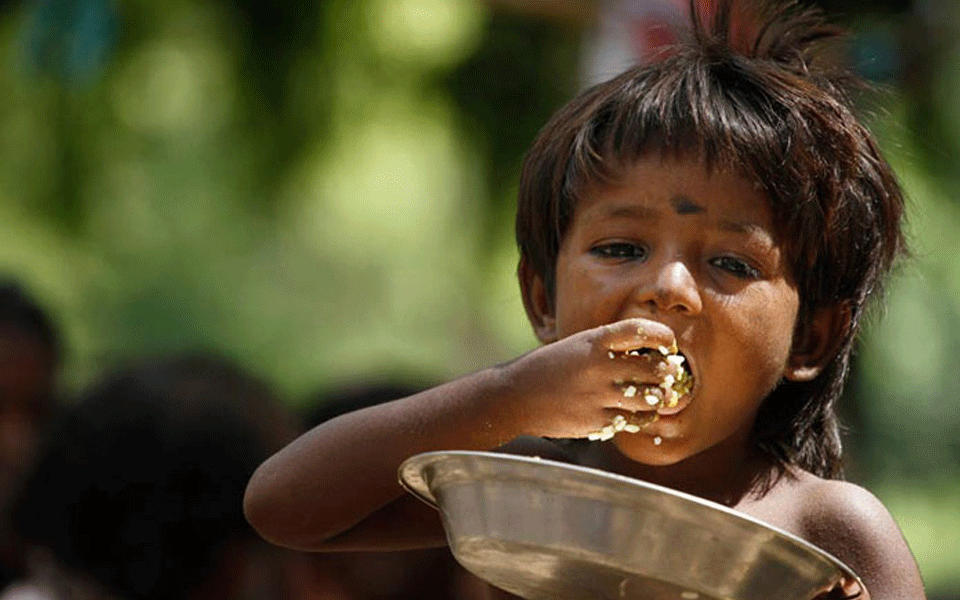
New Delhi: India is ranked 102 of 117 countries in the Global Hunger Index 2019, behind its neighbours Nepal, Pakistan and Bangladesh.
Seventeen countries, including Belarus, Ukraine, Turkey, Cuba and Kuwait, shared the top rank with GHI scores of less than five, the website of the Global Hunger Index that tracks hunger and malnutrition said on Wednesday.
The report, prepared jointly by Irish aid agency Concern Worldwide and German organisation Welt Hunger Hilfe termed the level of hunger in India "serious".
In 2018, it was ranked 103 out of 119 countries. In 2000, the country was ranked 83 out of 113 countries. Now, with 117 countries in the fray, it has dropped to 102 rank.
Its GHI score has also decelerated -- from 38.9 in 2005 to 32 in 2010 and then from 32 to 30.3 between 2010 and 2019.
The GHI score is calculated on four indicators -- undernourishment; child wasting, the share of children under the age of five who are wasted (that is, who have low weight for their height, reflecting acute undernutrition); child stunting, children under the age of five who have low height for their age, reflecting chronic undernutrition; and child mortality, the mortality rate of children under the age of five.
The share of wasting among children in India rose from 16.5 per cent in the 2008-2012 period to 20.8 per cent in 2014-2018, according to the report.
Just 9.6 per cent of all children between 6 and 23 months of age are fed a "minimum acceptable diet", it said. "India's child wasting rate is extremely high at 20.8 per cent, the highest for any country in this report," it said.
Countries like Yemen and Djibouti, which are conflict ridden and facing severe climate issues respectively, fared better than India on that front, according to the report.
Neighbouring countries like Nepal (73), Sri Lanka (66), Bangladesh (88), Myanmar (69) and Pakistan (94) are also in the 'serious' hunger category, but have fared better at feeding its citizens than India, according to the report.
China (25) has moved to a 'low' severity category and Sri Lanka is in the 'moderate' severity category.
However, India has shown improvement in other indicators such as the under-5 mortality rate, prevalence of stunting among children and prevalence of undernourishment owing to inadequate food, the report said.
The report also mentions the central government's Swachh Bharat programme, saying open defecation is still being practised.
"Even with new latrine construction, however, open defecation is still practised. This situation jeopardises the population's health and consequently, children's growth and development as their ability to absorb nutrients is compromised, the report said.
Let the Truth be known. If you read VB and like VB, please be a VB Supporter and Help us deliver the Truth to one and all.
44 peacocks die of H5N1 in Karnataka’s Tumakuru; minister orders precautions

Bengaluru (PTI): After 44 peacocks died of the H5N1 virus in Tumakuru district, Karnataka Minister Eshwar Khandre on Saturday directed officials to implement strict precautionary measures to prevent its spread across forest areas, including zoos and bird sanctuaries.
The directive comes after laboratory reports from the ICAR–National Institute of High Security Animal Diseases in Bhopal recently confirmed H5N1 avian influenza as the cause of the deaths.
According to the state forest minister, the peacocks died between April 16 and 21 in and around Bommanahalli and Kolihalli villages in Urdigere hobli, and Bairasandra and Hullenahalli villages in Gulur hobli of Tumakuru district.
“In this context, instructions have been issued in line with the revised H5N1 Action Plan of the Central Government to prevent the spread of infection across all forest areas, including zoos, bird sanctuaries, Magadi Lake, and the community reserve at Kokkare Bellur,” Khandre said in a note addressed to the principal chief conservator of forests (wildlife) and chief wildlife warden.
He also directed that any deaths of birds, whether migratory or local, must be reported immediately, and that samples from carcasses should be collected and sent for testing.
If required, a nodal officer may be appointed to monitor the situation across the state, he added.
Authorities have established an infected zone within a 0–3 km radius and a surveillance zone extending from 3 to 10 km.
According to the Health Department, surveillance for fever, Influenza-Like Illness (ILI), and Severe Acute Respiratory Infection (SARI) will be carried out over the next 10 days, covering a population of 20,432 across 38 villages.
In light of the situation, the department has advised the public to follow precautionary measures to minimise the risk of infection by avoiding contact with sick or dead birds and maintaining hand hygiene by washing hands frequently with soap and water.
It has also suggested the use of personal protective equipment (PPE) while handling birds or their droppings, and advised ensuring that poultry and eggs are thoroughly cooked (above 80 degrees celcius) before consumption.
The health department has also recommended avoiding close contact with individuals exhibiting symptoms of respiratory illness.
The department said it is closely monitoring the situation and has put necessary precautionary measures in place.
The public has been advised to remain vigilant and report any unusual bird deaths or symptoms promptly, officials added.
Avian influenza (H5N1) is a subtype of the influenza virus that infects birds and mammals, including humans in rare instances, according to the World Health Organisation. Human cases reported so far have been mostly linked to close contact with infected birds or other animals, or with contaminated environments.