Kerala culls 310 pigs to contain African Swine Fever outbreak
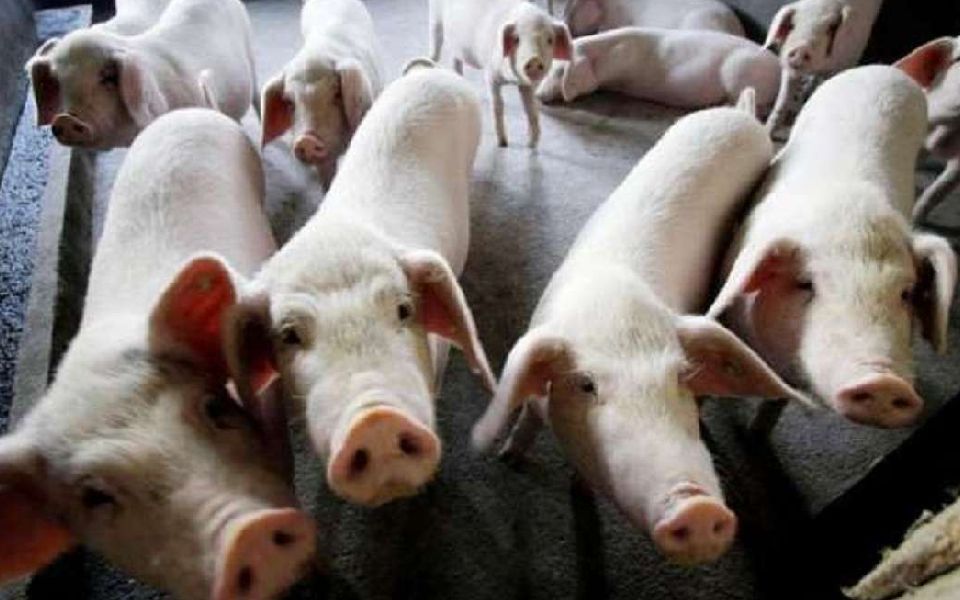
The Centre on Sunday said around 310 pigs have been culled in Kerala's Thrissur district after an outbreak of African Swine Fever (ASF).
The outbreak was detected in Madakkatharan Panchayath, prompting swift action from the state's Animal Husbandry Department.
Rapid Response Teams were deployed to cull and dispose of pigs within a 1 km radius of the epicentre on July 5, the Union Ministry of Fisheries, Animal Husbandry and Dairying said in a statement.
This marks the latest incident in the country's ongoing battle with ASF, which first appeared in the northeastern states of Assam and Arunachal Pradesh in May 2020. Since then, the disease has spread to approximately 24 states and union territories across the country.
'Further surveillance as per the action plan is to be carried out within a 10 km radius of the epicentre,' the ministry said.
Despite the outbreak's severity, the government was quick to reassure the public.
'ASF is not zoonotic. It cannot spread to humans,' the ministry clarified.
However, the lack of a vaccine for ASF underscores the challenges in managing animal diseases, it added.
The National Action Plan for Control of ASF, formulated in 2020, outlines containment strategies and response protocols for outbreaks.
Even as the country faces a new outbreak of ASF in Kerala, the central government marked World Zoonoses Day on July 6 with an interactive session.
The day -- commemorating Louis Pasteur's first successful rabies vaccine on July 6, 1885 -- serves as a stark reminder of the thin line between animal and human health.
Zoonoses diseases that can jump from animals to humans include familiar threats like rabies and influenza, as well as more recent concerns like COVID-19.
However, the ministry emphasised that not all animal diseases pose a threat to human health.
'It's crucial to distinguish between zoonotic and non-zoonotic diseases,' the ministry said, and added that 'many livestock diseases, like Foot & Mouth Disease or Lumpy Skin Disease, cannot infect humans'.
This distinction is particularly relevant for India, home to 11 per cent of the global livestock population and 18 per cent of the world's poultry. The country's animal health strategies have significant implications for its status as the world's largest milk producer and second-largest egg producer.
India's approach to zoonotic diseases is evolving. The government has launched nationwide vaccination campaigns for brucellosis in bovine calves and rabies.
Additionally, a National Joint Outbreak Response Team (NJORT) has been established under the One Health approach, bringing together experts from various ministries and research institutions, the statement said.
Let the Truth be known. If you read VB and like VB, please be a VB Supporter and Help us deliver the Truth to one and all.
Manipur: Mortal remains of children killed in bomb attack handed over to family
Imphal (PTI): The mortal remains of two children, who were killed in a bomb attack in Manipur's Bishnupur district in April, were handed over to family members on Saturday, officials said.
The bodies of the five-year-old boy and his six-month-old sister were kept in the morgue for 25 days, as the family members had refused to accept the mortal remains, demanding that the perpetrators be brought to book at the earliest.
On April 25, Chief Minister Y Khemchand Singh had appealed to the family members of the children to accept the bodies. Singh had also said that all efforts were underway to find the culprits.
The two children were killed in a bomb attack at Tronglaobi in Bishnupur district on April 7. Their bodies were kept in the morgue at the Regional Institute of Medical Sciences in Imphal.
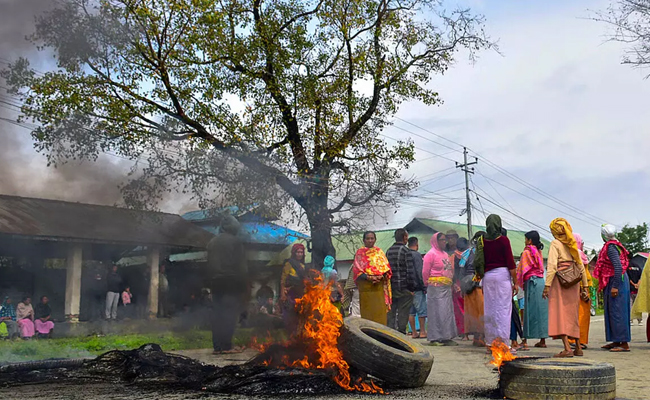
The incident had triggered widespread violent protests in the five valley districts of Manipur, and the case was subsequently handed over to the NIA.
Hundreds of people lined up along the way to Tronglaobi to offer floral tributes, as the mortal remains were taken for the last rites in an open vehicle earlier in the day.