Mamata tears into BJP, EC over SIR; warns of Modi govt’s fall if one eligible voter struck off rolls
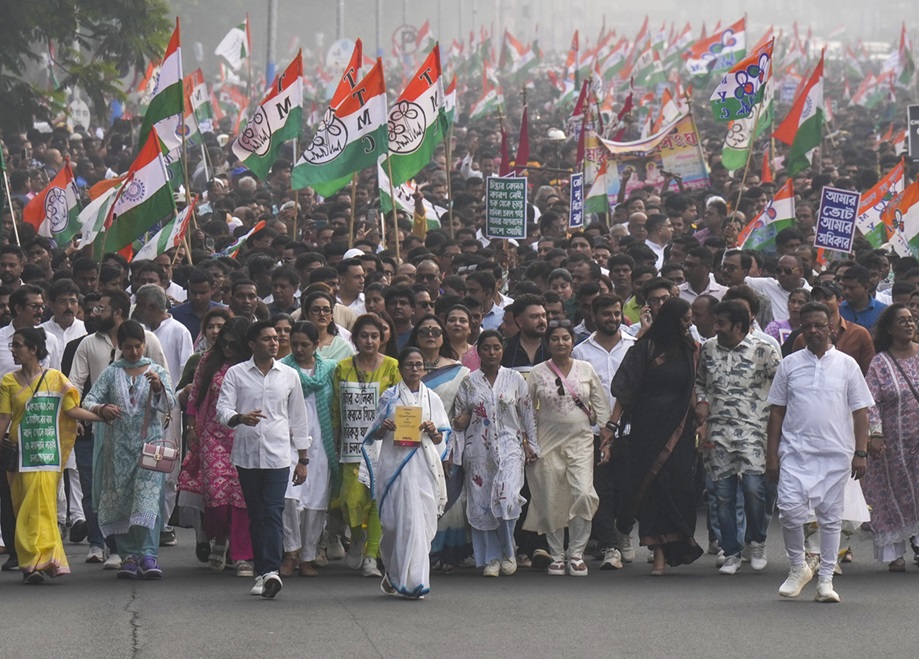
Kolkata (PTI): Mounting a blistering attack on the BJP and the EC, West Bengal Chief Minister Mamata Banerjee on Tuesday accused them of turning the ongoing Special Intensive Revision (SIR) of voter lists into a political tool for a "silent, invisible rigging" ahead of the 2026 Assembly polls.
She warned that the fall of the Narendra Modi government would be "inevitable" if even a single eligible voter was deleted from West Bengal's rolls during the SIR conducted by the Election Commission (EC) in the state.
Leading a massive anti-SIR rally through the heart of Kolkata, from Dharmatala to Jorasanko - the ancestral home of Rabindranath Tagore, the CM, accompanied by her nephew and TMC national general secretary Abhishek Banerjee, alleged that the BJP and the EC were "colluding to erase voters from opposition-ruled states" while sparing the ones governed by the saffron party.
"The BJP is conducting SIR in states like Kerala, Tamil Nadu and West Bengal, but not in BJP-ruled Assam, Tripura or other northeastern states," she thundered before a charged crowd.
The assembly polls are due in Kerala, Tamil Nadu, West Bengal Assam next year.
ALSO READ: SIR of electoral rolls begins in 12 states, UTs; TMC calls exercise a 'con job'
"Why is this bias? This is clear discrimination, aimed at helping the ruling party at the Centre," she said.
The Trinamool Congress supremo warned, "If even one genuine voter's name is struck off the rolls, the BJP government will be shaken to its core. The fall of this government will be inevitable."
Accusing the Chief Election Commissioner Gyanesh Kumar, whom she mockingly called "kursi babu", of acting under political pressure, Banerjee said, "In 2002, Bengal's last SIR took two years to complete. Why the hurry to finish this one in a month? Just to make Modi Babu and Amit Shah happy?"
Questioning the BJP's claim of illegal voters in Bengal, she said, "They say they will expel Bangladeshis and Rohingyas. How many Rohingyas did they find in Bihar after SIR? Just speaking Bengali doesn't make someone a Bangladeshi. Speaking Urdu doesn't make someone a Pakistani. Bengal's identity cannot be insulted like this."
The TMC chief accused Union Home Minister Amit Shah of hypocrisy.
"He criticises our so-called dynastic politics, yet he has appointed his own son to the highest post," she alleged, without naming him.
Taking on the Election Commission, the chief minister asked if the names of someone's parents are not on the list, would they have to prove again that they were born in this state?
"The Commission is creating multiple confusions in the rolls. Who will take responsibility for these mistakes? Wouldn't it have been better to conduct this exercise after the elections? Do we have to prove our citizenship even after so many years of birth and independence?" she said.
ALSO READ: ECI team to visit Bengal to review SIR procedures: Official
She said that the TMC would continue the fight against the issue both on the streets and in courts.
"We will extend our support if they conduct the SIR after the Assembly polls. But how can you do it just months before the elections? This is nothing but a politically motivated move to intimidate voters," she said.
Banerjee also alleged that names of many voters were already being removed in the name of "mapping" and that several people had died from panic caused by the SIR process.
"The BJP is behind this chaos. People are dying because of the fear they are spreading," she charged.
Drawing parallels with the Centre's controversial policies, she recalled, "I had opposed demonetisation. They still went ahead with it. What did people gain? Nothing but hardship and humiliation. And yet they never apologised. What a shameless government!"
Slamming the BJP for its alleged obsession with controlling institutions, she said, "They may win in deals, they may win through manipulation; but they will never win the people's mandate. They have big babus, small babus, and middle babus. I respect the chair, but there's a limit to how much you can bow down."
They have crossed all limits of oppression, the CM alleged.
Taking a dig at the ruling party's alleged hypocrisy over citizenship documents, Banerjee remarked, "You made people pay to get Aadhaar cards, and now you say Aadhaar isn't proof of citizenship! What nonsense is this?"
The CM also alleged that BJP workers, posing as bank employees, were collecting personal data of people in parts of Diamond Harbour, the Lok Sabha constituency of Abhishek Banerjee, and warned citizens against sharing information with unauthorised officials.
"Give information only to official BLOs. Suppose you are not at home, will your name then be removed? That's why we have set up a TMC helpdesk to assist people," she said.
In an emotional pitch to the crowd, Banerjee asked, "After serving seven times as an MP, three terms as the chief minister, and four terms as a central minister, do I still need to prove I'm not a Bangladeshi?"
She accused the BJP of hatching a conspiracy to strike off "nearly two crore voters" from West Bengal's rolls.
The CM said, "People (of West Bengal) are being branded as Bangladeshis just because they work in other states. These illiterates know nothing about our history of independence. Once, India, Pakistan and Bangladesh had been one. After independence, people went wherever life took them."
Reiterating that the state would not bow down before powers in New Delhi, Banerjee said, "This is not just about Bengal. This is about the soul of India, the right to vote, the right to belong. We will fight this both in Bengal and, if needed, in Delhi."
Let the Truth be known. If you read VB and like VB, please be a VB Supporter and Help us deliver the Truth to one and all.
A 99-run loss is unacceptable: Hayden blames batting horror
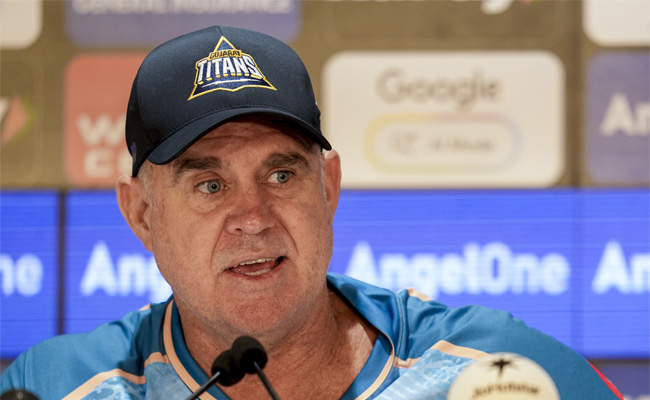
Ahmedabad (PTI): Gujarat Titans' batting coach Matthew Hayden was scathing about their 99-run defeat to Mumbai Indians, blaming a "horror" batting display and poor death bowling for the heavy loss in the IPL.
From being 44/3 in 5.5 overs, MI hammered 73 runs in the last four overs to post a challenging 199/5 here on Monday. In reply, GT were bundled out for 100.
"I expect our margins to be a lot smaller than 100 (99). That is an unacceptable scorecard for our batting unit," the legendary Australian opener told media in the post-match interaction.
"It was just a horrible day for us today. Truth be told, there was nothing good about this day, really, apart from Rabada's performance with the ball. so we've got some work to do, definitely."
GT boast a strong batting line-up in Sai Sudharsan (759 runs), Shubman Gill (717), and Jos Buttler (538). They have also added New Zealand’s explosive Glenn Phillips in the middle order alongside Shahrukh Khan and Rahul Tewatia.
"When you look down at our batting line-up, we've got wonderful players that have to be in a better mindset and better position to take their opportunities. That is our expectations and has been since the conception of this Gujarat Titans franchise...
"So you can't be sitting here and being happy about, a 100-run (99) margin game in a 20-over game. I mean, back in my day, 100 runs was almost a winning total in 50-over cricket!"
The 54-year-old said GT lost the game in the powerplay.
"Well, middle order was undoubtedly exposed today. When they're coming in with six overs, you know that you're in deep trouble. The thing about the power plays is that you can't win it from there, especially in a run chase, but you can definitely lose it, and we lost it in the power play," he said.
Shahrukh (35 off 25 balls) and Tewatia (49 off 42) have not fared well this season and Hayden feels the duo along with Phillips (67 off 54 balls) have been struggling because the top order has been below its best.
"The relevance behind balls faced when you look at, for example, someone like Glenn Phillips -- his record in T20 cricket is an impressive strike rate and you'll take that all day long in the majority of games," Hayden said.
"However, you need an upfront batting effort where you consistently taking the lion's share of the batting. We shouldn't be allowing, Tiwu (Tewatia) or Shahrukh or these guys lots of balls. That's not their role. That's not what they train for."
Hayden said GT has an aggressive and adaptable unit but their execution fell apart on the day.
"We are a very good thinking batting unit. We're not a conservative batting unit. You don't go out and get 200s as often as we do being conservative. But they're an adaptive batting unit. ...they've got their roles and they play them and today they simply didn't.
"So the worry isn't just today about the middle order. It'd be unfair to say that, they were going to go on and score 13 runs an over because by that stage, I felt like as a batting coach, I was on the mast and the boat was sinking."
It was poorly executed bowling effort
=======================
Hayden also pointed to poor execution in the death overs.
"I feel like one-dimensional is very unfair on a world-class bowling attack, but I will take on board it was a poorly executed bowling effort this evening.
"When you look back at those last four overs, that was just a 'horror story' -- 73 off the last four is unacceptable as world-class players. That bowling line-up has to reflect on that performance... It was purely an executional thing."
He added that GT were below par with the ball on a surface that didn’t fully justify the high total.
"We're very average with the ball, firstly, on a wicket that I really felt was probably a 175-type wicket.
"When you look historically at this black soil pitch on No. 5, it's a 200-wicket for the loss of five batters. That's been its winning first-inning score, and today it wasn't that wicket (199/5)... It was visible that it had cracks in it. It was visible that it was up and down.
"So credit also has to go to Tilak Varma, who put in a wonderful performance. It wasn't a cookie-cutter type performance. It was a dominant performance down the ground. He read the play nicely. He was able to pick up and play with power and precision."
Hayden said the chase was still within reach but poor shot selection proved costly.
"And when you reflect on our own batting, we had one side of the ground that was a little more inaccessible than the other, and we lost, what, three wickets into the bigger side of that boundary.
"And it wasn't an impossible total. 200 still is a total that I would back our three world-class players at the top of the order to etch into that a bit more and then allow our more sort of game players. An opportunity to set out their stalls and bat deep into the innings."