SC allows Hindus, Muslims to offer prayers at Bhojshala on Basant Panchami
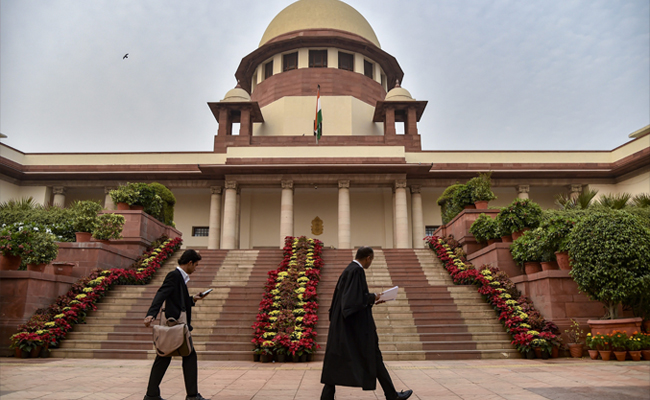
New Delhi (PTI): The Supreme Court has allowed Hindu prayers from sunrise to sunset on Basant Panchami on Friday at the disputed Bhojshala-Kamal Maula Mosque in Madhya Pradesh's Dhar district, while permitting Muslims to offer namaz from 1 pm to 3 pm on the day.
The top court on Thursday also directed that a list of persons from the Muslim community coming for namaz be given to the district administration.
Hindu and Muslim groups have sought nod for religious activities at the Bhojshala complex on January 23, a Friday when Saraswati Puja will also be held on the occasion of Basant Panchami.
A bench comprising Chief Justice of India Surya Kant and Justices Joymalya Bagchi and Vipul M Pancholi made an appeal to both sides to observe mutual respect and cooperate with the state and district administration for maintenance of law and order.
"ASG as well as Advocate General have fairly suggested that, after knowing that how many persons belonging to Muslim community are likely to come tomorrow for namaz between 1 to 3 pm, an exclusive and separate space within the same compound/ premises shall be made available, so that the namaz can be performed at the prescribed time.
"Similarly, a separate space, as per the past practice, shall be made available to the Hindu community to hold the traditional ceremonies on the occasion of Basant Panchami," the bench said.
It directed the district administration to make law and order arrangements at the site for offering of prayers.
"The district administration may, with a view to ensure maintenance of law and order, issue appropriate passes, free of cost, for the visitors or may adopt any other fair measures to ensure that no untoward incident takes place and the rituals are performed peacefully," the bench said.
Hindus consider Bhojshala, an Archaeological Survey of India (ASI)-protected 11th-century monument, to be a temple dedicated to Vagdevi (Goddess Saraswati), while the Muslim community calls it Kamal Maula mosque.
Under an arrangement made by the ASI on April 7, 2003, Hindus perform puja on the Bhojshala premises on Tuesdays and Muslims offer 'namaz' in the complex on Fridays.
The top court was hearing a plea filed by the Hindu Front for Justice seeking exclusive rights for Hindus to offer prayers on Basant Panchami.
The plea filed through advocate Vishnu Shankar Jain was mentioned for urgent hearing on Tuesday.
Jain had said the ASI's 2003 order does not address situations where Basant Panchami coincides with Friday prayers and sought exclusive, uninterrupted worship rights for Hindus for the entire day on Basant Panchami.
During the hearing, Jain submitted that there will be pujas and havans from sunrise to sunset and sought permission for worship throughout the day.
Senior advocate Salman Khurshid, for the mosque committee, submitted that the Friday namaz takes place between 1 PM and 3 PM, and the premises can be vacated after that.
Khurshid, while accepting this proposal, stated that the approximate number of persons belonging to Muslim community, who will come for namaz tomorrow will be furnished to the District Magistrate.
Additional Solicitor General KM Nataraj, for the Centre and ASI assured the court that the district administration will take care of the law and order situation.
The top court also disposed of an appeal filed by the Maulana Kamaluddin Welfare Society challenging the March 11, 2024 order of the Madhya Pradesh High Court on the “scientific survey” of the complex
The apex court directed the high court that the matter may be taken up by a division bench headed by one of the senior-most judges of the high court.
Noting that ASI has completed the scientific survey and has submitted its report in a sealed cover to the high court, the top court directed the high court to unseal the report and be supplied to the parties, who can file objections to it.
"If such part cannot be copied, the parties may be allowed to inspect in presence of their counsels. Let objections be filed and thereafter case be taken for final hearing.
"Till the writ is finally decided, the parties shall maintain status quo at the site. However, parties shall continue to follow and abide by ASI order of April 2023," the bench said.
Let the Truth be known. If you read VB and like VB, please be a VB Supporter and Help us deliver the Truth to one and all.
Man arrested with Rs 2.54-crore heroin in Mumbai

Mumbai (PTI): Police have arrested a man and seized over 500 grams of heroin worth Rs 2.54 crore in the illicit market from him in Mumbai, officials said on Friday.
The police's Anti-Narcotics Cell (ANC) made the drug seizure in Santacruz in the western suburbs. The operation was conducted by the Kandivali unit of the ANC on Thursday as part of a special crackdown against drug trafficking in the area, they said.
Acting on specific inputs, an ANC team conducted a raid in Santacruz (East) and intercepted a man. During a search, the team recovered 508 grams of high-grade heroin from his possession, an official said.
The seized contraband, a highly addictive, opioid drug derived from morphine, is estimated to be worth Rs 2.54 crore in the international market, he informed.
Following the seizure, a case was registered against the man under relevant sections of the Narcotic Drugs and Psychotropic Substances (NDPS) Act, 1985, and he was formally placed under arrest in the early hours of Friday.
The police are currently investigating the source of the drug and trying to identify the intended recipients of the consignment, he said.