SC questions Centre over transcripts of videos in Sonam Wangchuk detention case
_vb_87.jpeg)
New Delhi (PTI): The Supreme Court on Monday questioned the Centre about the transcripts of videos submitted by it against climate activist Sonam Wangchuk and said the translations should be precise in the age of Artificial Intelligence.
A bench of Justices Aravind Kumar and PB Varale told Additional Solicitor General KM Nataraj that it wanted actual transcripts of Wangchuk's statements from the government after senior advocate Kapil Sibal submitted that some of the words attributed to the activist were never said by him.
"Mr Solicitor, we want an actual transcript of the speech. What he relied upon and what you say are different. We will decide. There should be an actual transcript of what he says. You may have your reasons.
ALSO READ: 34 schools in Ahmedabad, Vadodara get bomb threat mails; cops declare them hoaxes after checks
"At least, whatever he stated, the true translation should be there... Your translation goes on for 7 to 8 minutes, but the speech is for 3 minutes. We are in the era of Artificial Intelligence; precision is at least 98 per cent for translation," the bench observed.
Sibal questioned the translation and said, "Wangchuk continued his strike… and also continued to provoke youth by taking reference of Nepal… Where is this line coming from? This is a very unique detention order — you rely on something that does not exist and then you say it is based on subjective satisfaction."
Nataraj told the court that there is a department for transcripts and said, "We are not experts in it."
The hearing will resume on Thursday.
The Centre had earlier told the apex court that Wangchuk had been examined medically 24 times since his detention and that he was "fit, hale and hearty."
Solicitor General Tushar Mehta told the bench that the grounds on which Wangchuk's detention order was passed continue to exist and that it would not be possible to release him on health grounds.
"We have examined his health periodically 24 times. He is fit, hale and hearty. He had some digestive issues; he is being treated. There is nothing to worry about, nothing alarming. We can't make exceptions like this.
"The grounds on which the detention order was passed continue. It will not be possible to release him on health grounds. It may not be desirable either. We have given utmost consideration," Mehta told the bench.
The top court was hearing a habeas corpus petition filed by Wangchuk's wife, Gitanjali Angmo, seeking a declaration that his detention under the National Security Act (NSA), 1980, is illegal.
The NSA empowers the Centre and the states to detain individuals to prevent them from acting in a manner "prejudicial to the defence of India."
The maximum detention period is 12 months, though it can be revoked earlier.
Angmo said the violence in Leh on September 24 last year cannot be attributed in any manner to the actions or statements of Wangchuk.
Wangchuk himself condemned the violence through his social media handles and categorically said it would lead to the failure of Ladakh's "tapasya" and its peaceful pursuit of five years, Angmo said, adding that it was the saddest day of his life.
Let the Truth be known. If you read VB and like VB, please be a VB Supporter and Help us deliver the Truth to one and all.
Mizoram class 12 results out, pass percentage at 87.67
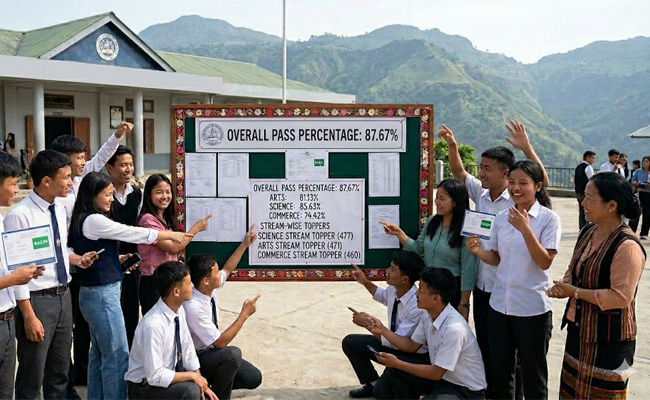
Aizawl (PTI): Mizoram recorded a pass percentage of 87.67 in the class 12 board examinations on Wednesday, with boys scoring marginally higher than girls,
Across the Arts, Science, and Commerce streams, boys secured an 87.7 per cent success rate, while girls followed closely at 87.66 per cent, according to the results published by the Mizoram Board of School Education (MBSE).
Of the 12,243 students who sat for the examinations held between February and March, 10,734 passed, 1,394 could not, and 115 qualified for compartmental examinations.
Academic performance was strongest in the Commerce stream, which saw a 90.51 per cent success rate among 759 candidates.
The Science stream followed with 89.24 per cent pass rate out of 2,770 students who appeared for the exam, while the Arts stream, with 87,14 students, recorded a pass percentage of 86.93.
In terms of institutional performance, the results revealed that deficit schools, which receive regular government grants, maintained their status as top performers with an average 93.80 per cent pass rate across all streams, followed by private schools at 91.55 per cent, while state-run schools recorded a success rate 83.13 per cent.