Sunni Waqf Board will drop claim to Babri Masjid land if other mosques are guaranteed protection
This News story was first published on www.thewire.in
Note: The story has been updated at 4:45 pm with details of the proposed settlement
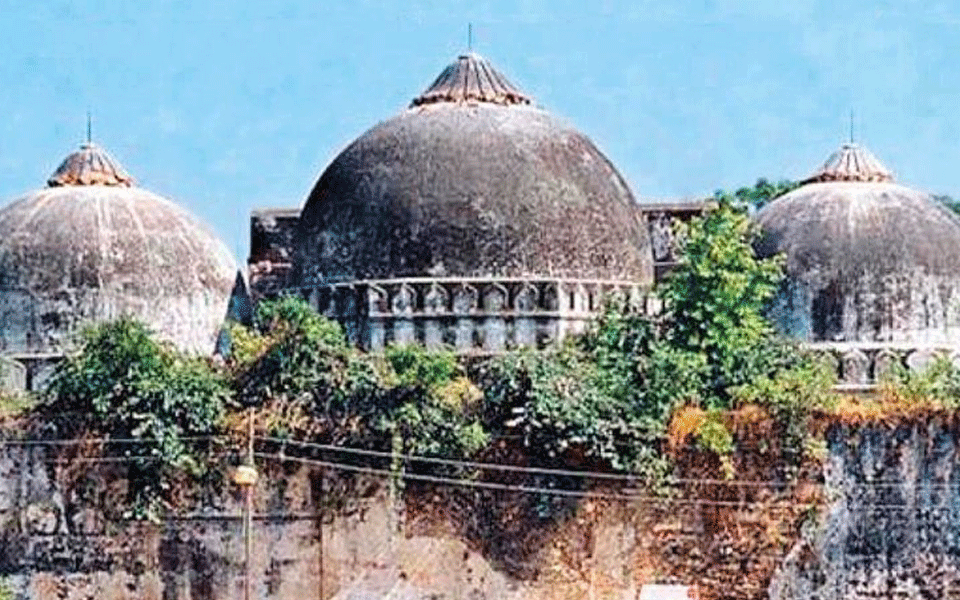
New Delhi: The primary Muslim litigant in the title dispute case has informed the Supreme Court that it is willing to drop its appeals in the matter – and its claims to the land on which the historic Babri Masjid stood for centuries before it was demolished by Hindutva activists and leaders in 1992 – provided the Centre is willing to guarantee that all other places of worship in India will be protected from similar encroachment.
“Settlement has been filed. I cannot say more now,” a source familiar with the proceedings told The Wire on Wednesday morning.
The court, however, continued with its hearings, and at the end of the day’s proceedings said it was reserving its judgment
Mediation proposal
The surprise development came on the last day of the hearings scheduled by the five judge-constitution bench of the Supreme Court. In virtually day-to-day hearings over the past few weeks, the bench, headed by Chief Justice Ranjan Gogoi, had heard arguments from the two Hindu litigants in the case – the Ramjanmabhoomi Nyas, controlled by the Vishwa Hindu Parishad, a front of the Rashtriya Swayamsevak Sangh, and the Nirmohi Akhara – as well as the Sunni Waqf Board.
Gogoi retires in the middle of November and the bench is expected to deliver its judgment in the landmark case by then.
According to informed sources, the Sunni Waqf Board and some but not all of the Hindu litigants have signed the settlement proposal, which has been submitted via the three-member mediation panel that the court had set up earlier this year.
Significantly, the VHP-backed Ramjanmabhoomi Nyas has not accepted the terms of the settlement.
Besides firm safeguards for all other mosques in India, the settlement envisages the renovation of 22 existing mosques in Ayodhya, permission to build another mosque in lieu of the Babri masjid at some other location, and the possibility of worship in a number of historic mosques which are currently under the care of the Archaeological Survey of India.
Headed by a former judge of the Supreme Court, Justice (retd) F.M.I. Khalifullah and comprising the respected advocate Sriram Panchu and the Art of Living founder Venkatratnam Ravishankar Ramanayakanpet (also known as Sri Sri Ravi Shankar), the mediation panel had earlier informed the court that an out-of-court-settlement could not be reached between the three parties to the dispute.
The Nyas and the Nirmohi Akhara want the land for the construction of a Ram temple, claiming the site as the birthplace of the Hindu god, and the former was earlier reportedly unwilling to accept any of the conditions that the Waqf board had mooted as part of any compromise.
Chief among these was an assurance that the Hindutva groups would drop their demands that other Muslim places of worship, especially in Mathura and Varanasi, be converted to temples.
Last month, however, the mediation panel informed the Supreme Court that were willing to take a second stab at mediation, largely at the urging of the Muslim side and the Nirmohi Akhara.
Asked what happens now that a settlement proposal has been formally submitted, sources familiar with the process said it was up to the bench to now decide how to proceed. “They could decide that having heard arguments for 40 days, they should adjudicate anyway. Or they may use the settlement agreement as the contours of their final orders.”
Asked if the bench could still rule in favour of Muslim claims to the title of the disputed land despite the Sunni Waqf Board’s willingness to compromise, the source said that the bench could disregard the settlement proposal altogether and proceed as it wished.
The Allahabad high court, in its judgment to the title suit dispute in 2010, had found some merit in the claims of each of the three parties and divided the 2.77 acres of land where the mosque stood equally between the three of them.
The 16th century mosque was built by the Mughal emperor Babar and became the subject of dispute in the 19th century, during British colonial rule.
Soon after independence, in December 1949, Hindutva activists surreptitiously placed idols of the baby Ram and Sita in the mosque, following which the premises were locked by the UP state government.
In February 1986, the locks were reopened as part of the erstwhile Rajiv Gandhi government’s policy of using communal politics for electoral gains. However, the biggest beneficiary of this strategy was the BJP, which used the Ramjanmaboomi issue to polarise society on religious lines and steadily enlarge its support base.
On December 6, 1992, senior BJP leaders Lal Krishna Advani, Murli Manohar Joshi, Uma Bharti and others were present in Ayodhya when a large mob of political activists who had been mobilised for the purpose climbed atop the mosque and began demolishing it, Within hours, it was reduced to rubble.
The criminal case filed by the Central Bureau of Investigation against Advani and others has been languishing for years. Despite the apex court saying in 2018 that the trial be expedited, no verdict is yet in sight.
Note: The story has been updated at 4:45 pm with details of the proposed settlement
Courtesy: thewire.in
Let the Truth be known. If you read VB and like VB, please be a VB Supporter and Help us deliver the Truth to one and all.
44 peacocks die of H5N1 in Karnataka’s Tumakuru; minister orders precautions
Bengaluru (PTI): After 44 peacocks died of the H5N1 virus in Tumakuru district, Karnataka Minister Eshwar Khandre on Saturday directed officials to implement strict precautionary measures to prevent its spread across forest areas, including zoos and bird sanctuaries.
The directive comes after laboratory reports from the ICAR–National Institute of High Security Animal Diseases in Bhopal recently confirmed H5N1 avian influenza as the cause of the deaths.
According to the state forest minister, the peacocks died between April 16 and 21 in and around Bommanahalli and Kolihalli villages in Urdigere hobli, and Bairasandra and Hullenahalli villages in Gulur hobli of Tumakuru district.
“In this context, instructions have been issued in line with the revised H5N1 Action Plan of the Central Government to prevent the spread of infection across all forest areas, including zoos, bird sanctuaries, Magadi Lake, and the community reserve at Kokkare Bellur,” Khandre said in a note addressed to the principal chief conservator of forests (wildlife) and chief wildlife warden.
He also directed that any deaths of birds, whether migratory or local, must be reported immediately, and that samples from carcasses should be collected and sent for testing.
If required, a nodal officer may be appointed to monitor the situation across the state, he added.
Authorities have established an infected zone within a 0–3 km radius and a surveillance zone extending from 3 to 10 km.
According to the Health Department, surveillance for fever, Influenza-Like Illness (ILI), and Severe Acute Respiratory Infection (SARI) will be carried out over the next 10 days, covering a population of 20,432 across 38 villages.
In light of the situation, the department has advised the public to follow precautionary measures to minimise the risk of infection by avoiding contact with sick or dead birds and maintaining hand hygiene by washing hands frequently with soap and water.
It has also suggested the use of personal protective equipment (PPE) while handling birds or their droppings, and advised ensuring that poultry and eggs are thoroughly cooked (above 80 degrees celcius) before consumption.
The health department has also recommended avoiding close contact with individuals exhibiting symptoms of respiratory illness.
The department said it is closely monitoring the situation and has put necessary precautionary measures in place.
The public has been advised to remain vigilant and report any unusual bird deaths or symptoms promptly, officials added.
Avian influenza (H5N1) is a subtype of the influenza virus that infects birds and mammals, including humans in rare instances, according to the World Health Organisation. Human cases reported so far have been mostly linked to close contact with infected birds or other animals, or with contaminated environments.