Swabhiman Parv: PM Modi leads Shaurya Yatra, offers prayers at Somnath temple
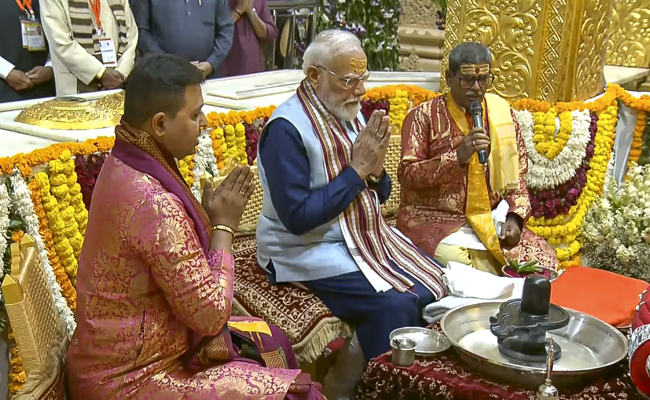
Somnath (Gujarat) (PTI): Prime Minister Narendra Modi on Sunday led 'Shaurya Yatra', a ceremonial procession organised to honour those who laid down their lives defending the Somnath temple in Gujarat's Gir Somnath district.
He also offered prayers at the historic temple and paid tributes to Sardar Vallabhbhai Patel, whose statue has been installed near the temple premises.
The 'Shaurya Yatra', being organised as part of the Somnath Swabhiman Parv, featured a procession of 108 horses, reflecting valour and sacrifice.
A large number of people and devotees gathered on both sides of the yatra route from Shankh Circle to Veer Hamirji Gohil Circle to greet the prime minister.
Standing on a specially designed vehicle, PM Modi, accompanied by Gujarat Chief Minister Bhupendra Patel, waved at the crowd during the one-km-long yatra.
A group of young priests, or 'rushi kumars', walked along Modi's vehicle playing 'damru', an instrument of Lord Shiva. At one point, Modi himself borrowed two damrus from a priest and played them while standing on his vehicle.
Artists from across the country, including Jammu and Kashmir, performed their traditional dances on stages erected at regular intervals along the route.
The yatra culminated at 'Veer Hamirji Gohil Circle', from where the path to the famous temple begins.
At the circle, Modi offered floral tributes at the statue of Hamirji Gohil, who had sacrificed his life defending the Somnath temple against the incursion of the Delhi Sultanate's army in 1299 AD.
Later, Modi paid floral tributes to Sardar Vallabhbhai Patel, whose statue has been installed near the entrance of the temple premises. Thanks to Patel's intervention, Somnath temple underwent restoration after Independence and it was formally opened to devotees in 1951.
PM Modi also offered prayers at the Somnath temple. He sat for a puja at the temple amid vedic chants by the chief priest.
The prime minister will later address people at a public function marking the Somnath Swabhiman Parv.
The event is being held to remember the countless citizens of India who have made sacrifices to defend the Somnath temple, which continues to inspire the cultural consciousness of future generations.
The programme marks 1,000 years since Mahmud of Ghazni's invasion of the Somnath temple in the year 1026.
Despite multiple repeated attempts for its destruction over centuries, the Somnath temple stands tall today as a powerful symbol of resilience, faith and national pride, owing to the collective resolve and efforts to restore it to its ancient glory, the PIB said in a statement.
Let the Truth be known. If you read VB and like VB, please be a VB Supporter and Help us deliver the Truth to one and all.
4 workers die after being buried under coal slurry in Jharkhand's Dhanbad
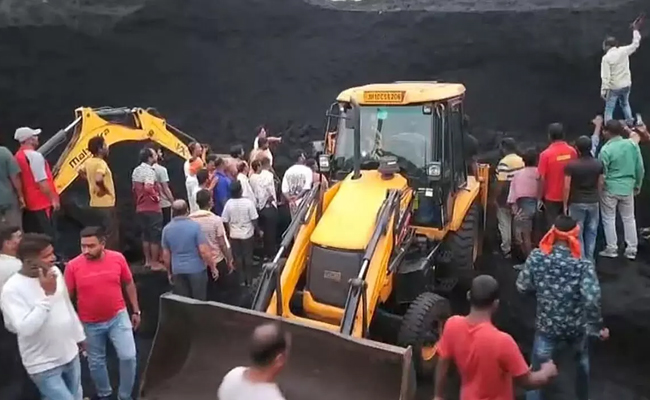
Dhanbad (Jharkhand) (PTI): At least four workers died after being buried under coal slurry in Jharkhand's Dhanbad district on Saturday, a police official said.
The incident took place at Moonidih coal washery in the command area of Bharat Coking Coal Limited (BCCL).
"Bodies of all four workers were dug out of debris during a rescue operation," Putki police station in-charge Waqar Hussain told PTI.
The incident took place when coal slurry was being loaded into trucks by workers, during which a large chunk of slurry fell and trapped several workers underneath, officials said.
The deceased have been identified as Manik Bauri, Dinesh Bauri, Deepak Bauri, and Hemlal Gope.
Meanwhile, the family members of the deceased and local villagers placed the bodies in front of the washery gate and began a protest.
They demanded compensation, jobs for dependents and action against those responsible for the incident.
Police and administration officials are trying to pacify the protesters, an official said.