Waqf row: Can't stay law made by Parliament when validity presumed, Centre tells SC
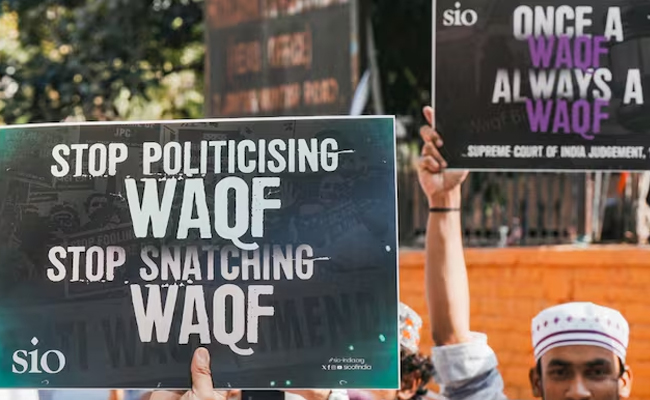
New Delhi (PTI): The Centre on Friday sought the Supreme Court to dismiss the pleas challenging validity of the Waqf (Amendment) Act, 2025 and said there cannot be a "blanket stay" on the law as there was a "presumption of its constitutionality".
In a 1,332-page preliminary counter affidavit, the government defended the contentious law saying that "shockingly" after 2013, there were an addition of over 20 lakh hectare (precisely 20,92,072.536) in waqf land.
"Right before even Mughal era, pre-independence era and post-independence era, the total of waqfs created was 18,29,163.896 acres of land in India," the affidavit said.
It claimed "reported misuse" of earlier provisions to encroach upon private and government properties.
The affidavit was filed by Shersha C Shaik Mohiddin, joint secretary in the Ministry of Minority Affairs.
"Settled position in law that constitutional courts would not stay a statutory provision, either directly or indirectly, and will decide the matter finally. There is a presumption of constitutionality that applies to laws made by Parliament," it added.
The Centre went on, "While this court would examine these challenges when the cases are heard, a blanket stay (or a partial stay) without being aware of the adverse consequences of such an order in a generality of cases (even on members of the Muslim community itself) were the petitions to be unsuccessful would, it is submitted, be uncalled for, especially in the context of the presumption of validity of such laws."
The affidavit said the pleas challenging the Act proceeded on false premise that amendments take away fundamental rights of religious freedom.
It said the court can review a law on the grounds of legislative competence and violation of fundamental rights under Article 32 of the Constitution.
The government said the amendments were undertaken after a very comprehensive, in-depth and analytical study by a parliamentary panel having members from major political parties .
"Parliament has acted within its domain to ensure that religious endowments like waqf are managed in a manner that upholds the trust reposed in them by the faithful and the society at large, without trespassing on religious autonomy," it said.
The law, the Centre said, was valid and result of a lawful exercise of legislative power.
The affidavit said replacing legislative regime, enacted by the legislature, was impermissible.
On April 17, the Centre had assured the top court that it would neither denotify waqf properties, including "waqf by user", nor make any appointments to the central waqf council and boards till May 5.
A bench headed by Chief Justice Sanjiv Khanna is slated to hear the matter on May 5 on passing of interim orders.
Let the Truth be known. If you read VB and like VB, please be a VB Supporter and Help us deliver the Truth to one and all.
Samson's unbeaten 87 powers CSK to eight-wicket win over DC

New Delhi (PTI): Sanju Samson bossed the chase with authority, anchoring a modest 156-run target with a fluent 87 not out as Chennai Super Kings outclassed Delhi Capitals by eight wickets in the IPL here on Tuesday.
Samson's knock came off just 52 balls with seven fours and six sixes, batting through the innings as CSK completed the chase in just 17.3 overs giving a huge boost to their net run-rate.
Electing to bat on a tricky surface, Delhi Capitals were restricted to 155/7.
West Indies left-arm spinner Akeal Hosein set the tone with the new ball, returning tidy figures of 1/19, including 14 dot balls.
Reduced to 69/5 in 11 overs, Delhi found some late impetus through Tristan Stubbs (38; 31 balls) and Sameer Rizvi (40 not out; 24 balls), who stitched together a crucial 65-run (off 47 balls) stand to give the innings a respectable total.
Brief Scores:
Delhi Capitals: 155 for 7 in 20 overs (Tristan Stubbs 38, Sameer Rizvi 40 not out; Noor Ahmed 2/22)
Chennai Super Kings 159 for two in 17.3 overs (Sanju Samson 87 not out, Kartik Sharma 41 not out). CSK win by eight wickets.