Who is Nobel laureate Omar M. Yaghi with Palestinian roots? Everything you need to know
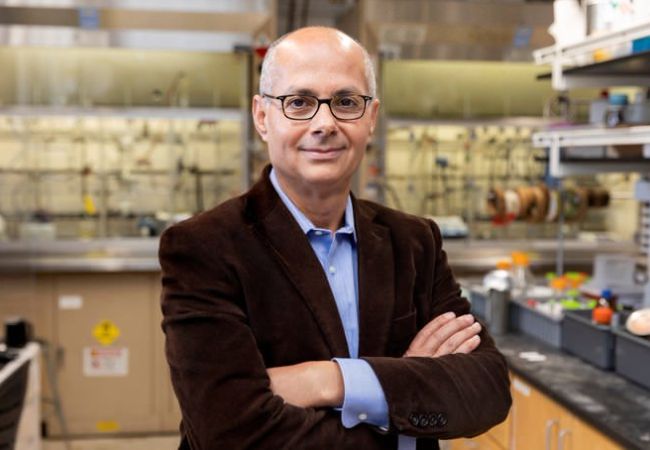
Berkeley/Amman: The 2025 Nobel Prize in Chemistry has shone a global spotlight on Omar Mwannes Yaghi, a Jordanian–American chemist of Palestinian origin, whose pioneering work in reticular chemistry and the development of metal–organic frameworks (MOFs) has transformed the landscape of materials science.
Yaghi, currently University Professor and James and Neeltje Tretter Endowed Chair in Chemistry at the University of California, Berkeley, shares this year’s Nobel honour with Susumu Kitagawa and Richard Robson for their contributions to developing metal-organic frameworks structures that can trap gases, harvest water from air, and drive sustainable chemical processes.
But beyond his scientific achievements, Yaghi’s story is deeply rooted in the resilience and struggle of his Palestinian refugee background.
Born in Amman, Jordan, in 1965, Yaghi was raised in a refugee family originally from Al-Masmiyya, a Palestinian village in the Gaza Subdistrict that was depopulated in 1948. His early years were marked by hardship he grew up in a small, overcrowded room shared with several siblings and even livestock. The family had no electricity and limited access to clean water.
At the age of 15, his father encouraged him to move to the United States in search of education and opportunity. Speaking very little English, he began his studies at Hudson Valley Community College, later transferring to the State University of New York at Albany, where he completed his undergraduate degree.
He earned his Ph.D. in Chemistry from the University of Illinois at Urbana–Champaign in 1990, under the mentorship of Walter G. Klemperer, followed by postdoctoral research at Harvard University (1990–1992) under Richard H. Holm.
In 2021, his global contributions were further recognised when Saudi Arabia granted him citizenship by royal decree.
Yaghi began his academic career as an assistant professor at Arizona State University (1992–1998) before moving to the University of Michigan (1999–2006) and then to UCLA (2007–2012). In 2012, he joined UC Berkeley, where he continues to lead groundbreaking research.
Over the years, he has directed key scientific institutes, including the Molecular Foundry at the Lawrence Berkeley National Laboratory, the Berkeley Global Science Institute, and the Kavli Energy NanoSciences Institute. He also co-directs the California Research Alliance by BASF and the Bakar Institute of Digital Materials for the Planet.
In 2025, the University of California Board of Regents elevated him to the rank of University Professor, the system’s highest academic honour.
In the early 1990s, Yaghi proposed a then-radical idea — building crystalline materials using strong chemical bonds between molecular building blocks. Many believed such structures would collapse into amorphous solids. But in 1995, he successfully crystallized metal-organic compounds, where metal ions were linked by charged organic molecules like carboxylates.
This breakthrough gave birth to metal–organic frameworks (MOFs) — crystalline, porous materials that can absorb and store gases like carbon dioxide, purify water, or even extract water from desert air.
His innovations, including the introduction of secondary building units (1998) and the development of MOF-5 (1999), opened new possibilities for clean energy, environmental sustainability, and industrial chemistry.
Today, reticular chemistry, the field Yaghi founded, is considered one of the most transformative branches of modern chemistry.
Yaghi’s influence extends far beyond the laboratory. He has received dozens of international honours, including the Wolf Prize in Chemistry (2018), the Albert Einstein World Award of Science (2017), the VinFuture Prize (2022), and the Science for the Future Ernest Solvay Prize (2024).
He has also been elected to the U.S. National Academy of Sciences and the German National Academy of Sciences Leopoldina, and in January 2025, he became the seventh president of the World Cultural Council, an international organization promoting cultural and scientific progress.
For many across the Arab world, Yaghi’s Nobel recognition is not only a scientific triumph but also a story of perseverance and identity. From a childhood in a displaced Palestinian family to becoming one of the most cited scientists in the world, his journey represents hope, the belief that knowledge can rise above borders and circumstances.
Let the Truth be known. If you read VB and like VB, please be a VB Supporter and Help us deliver the Truth to one and all.
KKR defeat LSG via Super Over

Lucknow (PTI): Kolkata Knight Riders edged Lucknow Super Giants via Super Overs in a battle between two bottom-placed teams in the IPL, here on Sunday.
Chasing a modest 156, LSG suffered a batting collapse and managed to tie the contest and take it to Super Over with No. 9 Mohammed Shami striking a last-ball six against a wayward Kartik Tyagi, who leaked 16 runs in the final over.
But Sunil Narine bowled a stunning Super Over conceding just one run and taking two wickets to give KKR an easy target.
Rinku Singh then finished the chase with a boundary off first ball from Prince Yadav.
Earlier the KKR were in deep trouble with 93/7 in 15 overs but Rinku smashed a sensational 83 not out from 51 balls including four sixes in a row in the final over to lift them to 155/7.
Cameron Green (34) was the only other batter to reach double-digit scores as KKR suffered a familiar batting meltdown with Mohsin taking his maiden fifer.
In reply, LSG continued their dismal show with the bat to succumb to their fifth loss in a row.
Brief Scores:
Kolkata Knight Riders 155/7; 20 overs (Rinku Singh 83 not out, Cameron Green 34; Mohsin Khan 5/23). Lucknow Super Giants 155/8; 20 overs (Rishabh Pant 42). KKR won via Super Over.