BJP conspiring to eliminate Rahul Gandhi, alleges CM Siddaramaiah
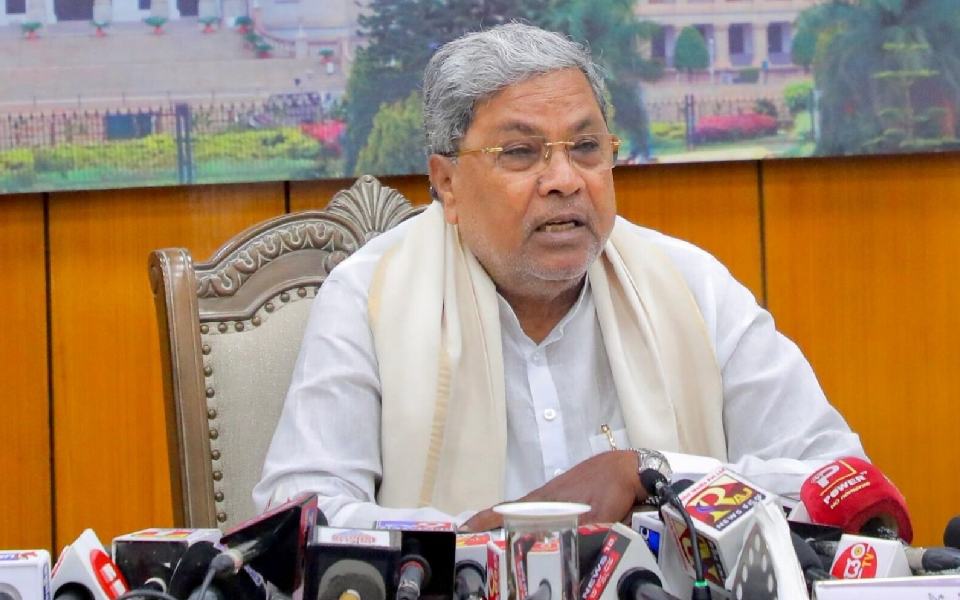
Shivamogga: Karnataka Chief Minister Siddaramaiah has alleged that the BJP is conspiring to politically and physically eliminate Congress leader Rahul Gandhi. Speaking at a press conference at his Home Office, Krishna, on Wednesday, Siddaramaiah expressed alarm over the threats to Gandhi’s life, urging immediate legal action against those involved.
The Chief Minister emphasized that Gandhi, who comes from a family that has sacrificed much for the nation, remains undeterred by these threats. “Rahul Gandhi is from a family of martyrs, including former Prime Ministers Indira Gandhi and Rajiv Gandhi. Despite the dangers, he continues his fight for the country,” said Siddaramaiah.
He accused the BJP of threatening Gandhi, with some even warning that he might meet the same fate as his grandmother, Indira Gandhi. Siddaramaiah also pointed to remarks by a Union Minister of State for Railways, who allegedly called Gandhi a terrorist.
ALSO READ: 'One Nation, One Election' against federal structure, practically impossible: CM Siddaramaiah
Further intensifying his criticism, Siddaramaiah condemned Shiv Sena MLA Sanjay Gaikwad (Shinde faction) for reportedly offering a ₹11 lakh reward for cutting out Gandhi’s tongue. Gaikwad allegedly made death threats against Congress workers as well. The Chief Minister demanded immediate criminal action against Gaikwad, calling for his arrest.
Siddaramaiah criticized the BJP for its inaction against such threats. He condemned a minister from Uttar Pradesh for labeling Rahul Gandhi as the country’s “number one terrorist,” noting that no strict measures had been taken against him.
In a broader political attack, Siddaramaiah predicted that Prime Minister Narendra Modi would not complete his five-year term, citing current political dynamics. He suggested that key allies, including Bihar Chief Minister Nitish Kumar and Andhra Pradesh Chief Minister Chandrababu Naidu, would soon part ways with the central government.
Siddaramaiah also addressed the controversy surrounding BJP MLA Muniratana, who has been accused of making derogatory remarks against women, the Dalit community, and the Vokkaliga community. Legal action has been initiated, and Muniratana has been arrested and presented in court.
The Chief Minister called for the formation of a special investigation team to probe the case further.
Let the Truth be known. If you read VB and like VB, please be a VB Supporter and Help us deliver the Truth to one and all.
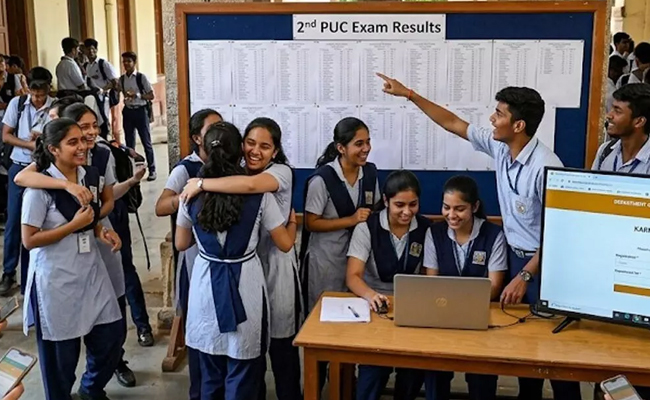
Second PUC results: Life convict clears exam with distinction, DGP lauds effort
_vb_63.jpeg)
Bengaluru: A life convict lodged in Ballari Central Prison has successfully cleared the second PUC examination.
Ashok Kumar S, who appeared for the examination under prison escort, secured 481 marks out of 600, registering 80.1 percent.
Director General of Police (Prisons and Correctional Services), Alok Kumar (IPS), shared the development on his official ‘X’ handle, commending the inmate’s achievement.
In his post, he stated that it was heartening to see a life convict score over 80 percent in the examination, adding that the inmate had appeared from Ballari Central Prison under escort.
It’s heartening to see that one of our life convict prisoners Ashok has obtained 80.1% marks in PUC exam. He appeared under Prison escort from Ballari Central Prison for his exams.
— alok kumar (@alokkumar6994) April 9, 2026
Glad to see that Walls of the prison has not subdued his hopes for a better future. pic.twitter.com/Nzlcy076SR
He further noted that the achievement reflected that the “walls of the prison have not subdued his hopes for a better future.”
Alok Kumar in his post also shared the result sheet of Ashok.
The Karnataka School Examination and Assessment Board (KSEAB) declared the second PUC results for 2026 on April 9.
A total of 6,32,200 students appeared for the examination across all streams, of whom 5,46,698 passed, recording an overall pass percentage of 86.48 per cent.