Cong makes all out bid to pacify rebels against Deve Gowda to withdraw from contest
Tumkur LS Seat
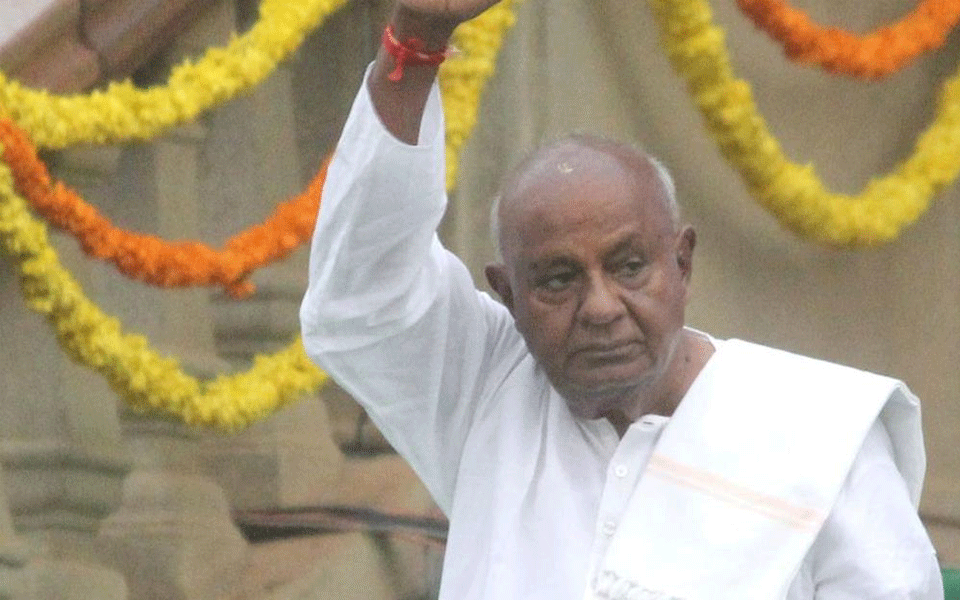
Bengaluru, Mar 27: With two days left for withdrawal of nominations for the first phase of Lok Sabha polls in Karnataka, Congress leaders are making all attempts to pacify the party's rebel candidates against former Prime Minister H D Deve Gowda, the ruling alliance's nominee in Tumkur.
Defying the electoral arrangement under which Tumkur was allotted to JD(S), sitting Congress MP S P Muddahanumegowda filed his papers on Monday both as party candidate and also as an independent.
K N Rajanna, another Congress leader and former MLA, has also filed his nomination from Tumkur as an independent candidate, opposing Gowda.
Both leaders are upset against Congress' decision to cede the Tumkur seat to JD(S), despite the party having its sitting MP there.
Pradesh Congress Chief Dinesh Gudu Rao expressed confidence about solving the issue amicably.
"We are confident that it will be fine. I'm talking to him (Muddahanumegowda), I have hundred per cent faith that there won't be any problem," he said.
Responding to a question on Rajanna, he said, "I'm in touch with him and he has said that he will abide by the party's stand and won't take any decision against the Congress party...We will solve it definitely."
Deputy Chief Minister G Parameshwara, who hails from Tumkur, also expressed confidence that Muddahanumegowda would withdraw in the larger interest of defeating the BJP.
"I have spoken to Muddahanumegowda. I have also informed our high command and they will also speak to him.
I'm confident that Muddahanumegowda being a gentleman politician will withdraw in the larger interest to defeat the BJP," he said.
Muddahanumegowda is determined to contest, as he is the only member among 10 sitting Congress MPs from the state who have not got the ticket this time.
JD(S) bagged Tumkur seat after a hard bargain with Congress as the grand old party did not concede Mysore, another seat it had demanded, due to strong resentment from CLP leader Siddaramaiah, as it is his home turf.
Mysore and Tumkur both come under old Mysuru region, where the Vokkaliga community, seen as a strong vote bank of the JD(S), is dominant.
Congress too has considerable presence there.
Speaking to local news channels in Tumkur, Muddahanumegowda said that he will not backtrack and will contest the polls as per the wish of his voters and supporters.
Stating that he has filed his nomination, both as a Congress candidate and an independent, he said, "I did not get the Congress ticket till Tuesday evening (last day to file nomination), but both alliance partners still have a chance to declare me as their candidate."
Speaking to reporters Rajanna said his decision would depend on what Muddahanumegowda agrees to.
Stating that he supports Muddahanumegowda, he said "I will wait for his decision...
There is pressure on me to withdraw, but I have not decided yet...", he said.
Deve Gowda opted for Tumkur seat over Bangalore North, another option that was available before him, after giving up Hassan Lok Sabha seat that he had been representing to his grandson Prajwal Revanna.
If Muddahanumegowda contests from Tumkur as a rebel candidate, it will add to the Congress-JD(S) coalition woes as the alliance is facing a backlash at several places,including Mandya and Hassan, with party workers unhappy with the seat arrangements.
Tumkur will go to the polls in the first phase on April 18
The last date for withdrawal of nominations is March 29.
Let the Truth be known. If you read VB and like VB, please be a VB Supporter and Help us deliver the Truth to one and all.
Maharashtra sets up state vaccination task force to strengthen immunisation programme

Mumbai (PTI): The Maharashtra government has set up a State Vaccination Task Force to strengthen the regular immunisation programme and review the progress of related campaigns, a health department official said on Monday.
The State Vaccination Task Force will comprise at least 29 members and will be headed by the administrative head of the health department, he informed.
The government has also constituted separate district-level and municipal vaccination task forces to improve implementation and address challenges at the grassroots level, he said.
Municipal task forces, chaired by respective civic commissioners, have been constituted in view of the vast urban population in Maharashtra and the role of civic bodies in implementing different health programmes.
The district-level task forces will function under the chairmanship of collectors.
"Complete immunisation of children at the appropriate age is an extremely simple, cost-effective and highly effective measure to reduce child mortality and the prevalence of diseases among kids. Immunisation is a powerful tool for reducing illness in children," maintained the official.
To ensure full vaccination of all children, the state government implements various campaigns from time to time as per the central government guidelines, he pointed out.
"Active participation and cooperation of other relevant government departments are essential (in making these campaigns successful)," according to the official.
The state-level body will review the regular immunisation programme, associated campaigns and vaccine-preventable diseases in detail. It will also conduct focused assessments of high-risk districts and municipal corporations, including vacancies at district, municipal and sub-district levels, availability of cold chain equipment, resource gaps and training requirements, he noted.
The state task force will review allocation and utilisation of funds for immunisation and ensure timely action by officers concerned based on reports from district and municipal task forces and state-level monitoring mechanisms, the official said.
It will also ensure active coordination and participation of other government departments in immunisation drives, while district and municipal task forces will carry out similar functions at their respective levels, the official added.