Gauri Lankesh was identified as "Durjan" by crime syndicate that plotted her murder: SIT

Bengaluru, Nov 26: Late journalist-activist Gauri Lankesh was identified as 'Durjan' (evil person) by the crime syndicate that plotted her murder, the Special Investigation Team probing the case has said, adding artificial intelligence systems were used to verify identity of suspected people in the killing.
Inspired by the Goa-based right wing outfit Sanatan Sanstha literature, the syndicate, comprising 18 people, named Lankesh as "Durjan" in August 2016 and started hatching a conspiracy to kill her, the SIT said.
The 55-year-old Lankesh, known for her left-leanings and strident anti-Hindutva views, was shot dead in front of her house here on September 5 last year, triggering national outrage and widespread condemnation.
The SIT said artificial Intelligence systems were used to extract images of suspected people and vehicles to compare with the footage obtained from 200 terabytes of video data from the CCTV cameras installed at major roads and junctions by the Bengaluru City Police.
The SIT said it interviewed and examined more than 2500 people and also traced 10,000 suspected two-wheelers and interviewed their owners.
Experts also analysed lakhs of cell phone tower dumps and mobile phone numbers, it said.
The SIT had filed the first charge sheet in May and the additional one on Friday last.
In August 2016, at a meeting of the Syndicate, the main members identified Lankesh as a "Durjan" "as told in the Kshatra Dharma Sadhana based on her speeches and writings," the SIT said.
They jointly hatched a conspiracy to murder Lankesh in furtherance of the achievement of their goal and executed it in several parts, the SIT said detailing the progress of investigation after filing the additional charge sheet.
Two months after the gang zeroed in on Lankesh, its member Vasudev Suryavamshi alias Mechanic and Sujith Kumar stole a bike and gave it to the alleged mastermind Amol Kale, it said.
Further, Dada alias Nihal, who is at large, assigned H L Suresh to find the address of Lankesh, it said, adding, Amit Baddi and Ganesh Miskin carried out the recce on her.
A fortnight before the killing, syndicate members Parashuram Waghmare and Ganesh Miskin carried out shooting practice in a hilly region near Kiniye in Belagavi, according to the SIT.
The team said Bharat Kurne took Ganesh Miskin, Parshuram Waghmare and Sharad Kalaskar to Kiniye.
Sharad Kalaskar trained Waghmare and Miskin how to shoot using country made pistols.
The shooting practice was last of the final preparations and planning, the SIT said.
According to the investigation team, the first attempt to kill Lankesh was made on September 4 but it did not materialise.
The next day, Ganesh Miskin rode the bike while Waghmare was the pillion rider.
They parked their bike near Lankesh's house and waited for 10 minutes.
Soon after Lankesh came home, Waghmare fired four bullets, killing her instantaneously, the SIT said.
While 16 members have been arrested, two are still at large.
They have been identified as Vikas Patil alias Dada and Rushikesh Deodikar alias Murali, the SIT said.
During the probe, the SIT said, various line of investigations were taken up probing the angle of personal enmity, involvement of left-wing extremism, profession related and right wing extremism.
However, "The first breakthrough in the case happened when the material objects recovered from the scene of crime were analysed at the State Forensic Science Laboratory here.
The forensic ballistic analysis established that the pistol used to murder Lankesh was the same pistol used to murder MM Kalburgi at Dharwad in Karnataka and Govind Pansare at Kolhapur in Maharashtra (all rationalists), the SIT said.
Footage of several CCTV systems within a radius of five km of Lankesh's house were collected and examined minutely for further clues. This included footage of four CCTV cameras installed at Lankesh's house.
Let the Truth be known. If you read VB and like VB, please be a VB Supporter and Help us deliver the Truth to one and all.
Two injuries, one DNF, a DQ as India end messy World Relays campaign
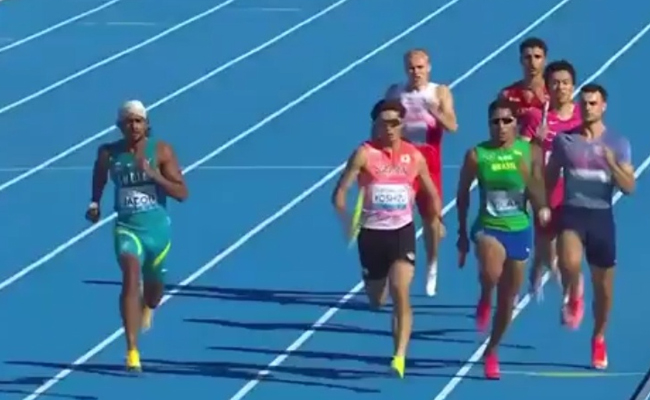
Gaborone (Botswana) (PTI): Amoj Jacob and Ragul Kumar got injured during the men's 4x400m and 4x100 races respectively as India ended their World Athletics Relays campaign in disappointment on the second day of competitions here on Sunday.
The Indian camp had high hopes of making the 2027 World Championships in the men's 4x400m relay but the team did not finish (DNF) the race as Jacob suffered cramps and pulled out of the race after taking the baton from the first leg runner Dharamveer Choudhary. Rajesh Ramesh and Vishal TK were to run in the third and fourth legs.
Those teams which could not qualify for the 2027 Beijing World Championships by reaching the final round of each of the six relay events on Saturday were given another chance in the second qualification round on Sunday.
The top two teams in each of the two heats (in all six relay events) booked the Beijing ticket on Sunday.
India will now have to try and qualify for the World Championships through the Top Lists of the World Athletics, which is a long and tedious process.
In the men's 4x100m race, third leg runner Ragul Kumar fell down the track after failing to hand over the baton inside the exchange zone to fourth leg runner Gurindervir Singh, which clearly showed the lack of coordination among the runners.
Harsh Santosh Raut and Animesh Kujur ran the first two legs.
The Indian quartet was disqualified and Kumar was seen being taken away from the Field of Play with the help of the volunteers.
It was a comedy of errors in the case of the women's 4x100m race, which saw the baton being dropped during an exchange between first leg runner Tamanna and second runner Nithya Gandhe, though the Indians finished the race in 53.09 seconds.
Gandhe started running quite a distance, but after realising that the baton was not in her hand, she turned and ran back to pick it up.
The only silver-lining for the Indian contingent was the national record time in the mixed 4x100m relay race, though the quartet of Ragul Kumar, Nithya Gandhe, Animesh Kujur and Sneha SS finished sixth in heat number two with a time of 41.35 seconds, bettering the previous national mark of 42.30 seconds set in March in Chandigarh.
The mixed 4x400m relay quartet of Theerthesh P Shetty, Kumari Saloni, Nihal William and Rashdeep Kaur ended at fifth in heat number one with a time of 3 minutes and 19.40 seconds.
On Saturday, all the five Indian relay teams had failed to make it to the respective final rounds and thus missed out on the 2027 World Championships berths.