Infosys arm to build cybercrime probe centre in Bengaluru
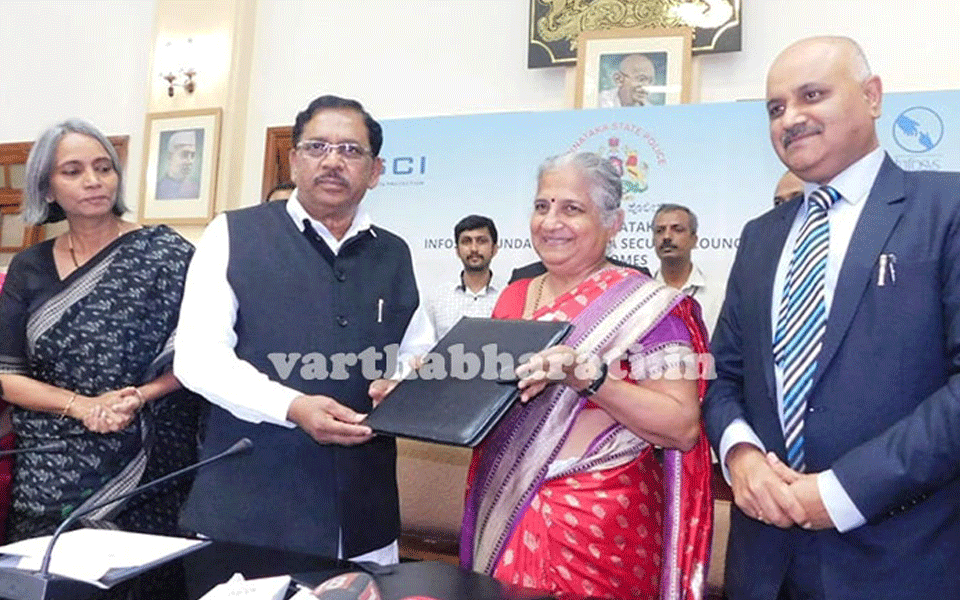
Bengaluru, Oct 3: Global software major's philanthropic arm Infosys Foundation on Wednesday said it would build the Centre for Cybercrime Investigation Training and Research (CCITR) in Bengaluru for the Karnataka Police.
"The centre aims to train police, prosecution, judiciary and other departments in handling technology investigations and create standard operating procedures in cybercrime investigations," said the city-based Infosys Foundation in a statement.
The Foundation has signed an agreement with the Criminal Investigation Department (CID) of the state police and the IT industry body Nasscom-owned Data Security Council of India (DSCI) to set up the centre.
Through hacking, online harassment, unwarranted surveillance, frauds, copyright infringement and other means, cybercrime not only hurts individuals, but is a threat to nations, causing billions of dollars of damage to the global economy.
The facility will be used to perform research in digital forensics and cybercrime investigation to improve the prosecution of cybercrime cases investigation by Karnataka Police, the statement added.
The Foundation said it will bear the costs incurred in setting up, operation and maintenance of the technological infrastructure at the centre and will provide the investment for hardware, software and capital required for holding training programmes.
The cost involved in setting up of the centre, however, has not been specified.
"We will also support the upgradation of the existing cyber lab for a period of five years along with technological infrastructure by providing specialised tools and incurring licensing costs," it added.
The centre will be a project for both present and the future, said Infosys Foundation Chairperson Sudha Murty in the statement.
"We aim to build state-of-the-art facilities to tackle cyber and forensic crimes in Karnataka. Once operational, the centre will be a milestone to curb misuse and unethical use of technology to create distress for fellow beings," said Murty.
With cybercrime said to become one of the largest organised crimes in the near future, law enforcement agencies need to be equipped with the hardware, software and expertise to face the challenges ahead, Karnataka CID Director General of Police Praveen Sood said.
"Cyberspace has turned out to be the world's largest ungoverned space demolishing all geographical boundaries. The centre will improve the investigation and prosecution of cybercrime," added Sood.


Let the Truth be known. If you read VB and like VB, please be a VB Supporter and Help us deliver the Truth to one and all.
Primary accused in 96.6 pc POCSO cases were close acquaintances: NCRB

New Delhi (PTI): In 96.6 per cent of 44,126 cases of sexual abuse of minors, close acquaintances have emerged as the primary offenders, according to the latest data released by the NCRB.
In its report 'Crime in India 2024' released by the National Crime Records Bureau (NCRB), 44,126 total cases have been registered under the Prevention of Children from Sexual Offences (POCSO) Act under Sections 4 and 6 which pertain to penetrative sexual assault on minors during the year across the country.
The figures present a grim picture as close acquaintances emerged as primary accused in 42,634 (around 96.6 per cent) of the 44,126 total cases falling in that category, according to the latest NCRB data.
The data shows that family members were involved in 3,658 cases, while family friends, neighbours, employers or other known persons were named in 16,668 cases.
The largest share came from friends, online friends or live-in partners acting on the pretext of marriage, with 22,308 cases.
Cases where the offender was unknown or not identified stood at mere 1,492, or 3.4 per cent of the total.
Among states, Tamil Nadu reported the highest number of POCSO cases at 5,320, followed by Maharashtra at 4,829 and Madhya Pradesh at 3,721. Uttar Pradesh was next with 3,671 cases.
In Union territories, Delhi accounted for the highest number of cases at 1,038, followed by Jammu and Kashmir at 228 and Puducherry at 82. The Andaman and Nicobar Islands reported 77 cases.
The data also shows that Andhra Pradesh, Arunachal Pradesh, Himachal Pradesh, Nagaland, Sikkim, Uttarakhand, Tripura and several Union territories, including Chandigarh, Andaman and Nicobar Islands, Dadra and Nagar Haveli and Daman and Diu, Lakshadweep, Ladakh and Puducherry, reported 100 per cent of cases involving known offenders.