Mortal remains of Jaffer Sharief laid to rest with full state honour

Bengaluru, November 26: The mortal remains of former union railway minister and senior Congress leader CK Jaffer Sharief who died on Sunday laid to rest at the Khuddus Sab Kabristan in the city on Monday with full state honour.
The body of Sharief was brought to KPCC office on Queens Road from his house at Coles Park in the city. KPCC president Dinesh Gundu Rao, Mayor Gangambike, Minister UT Khader, MLA NA Haris, Former speaker Veeranna Mattikatti, Former minister Vinay Kulkarni and other leaders paid their homage to the departed soul.
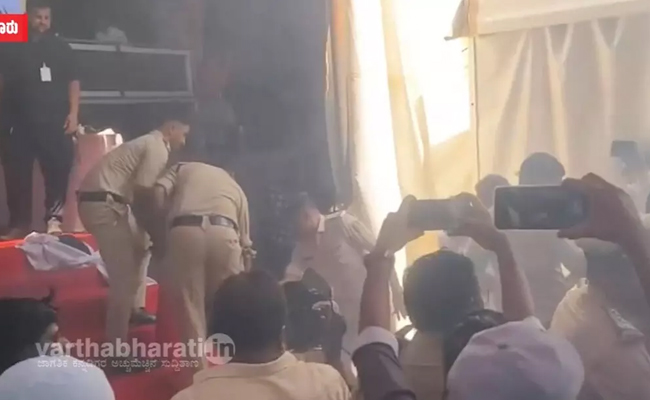
Later, the body was taken to the Khuddus Sab Eidgah Maidan at Benson Town. At this time, in front of Chief Minister HD Kumaraswamy, Opposition Leader in the Rajya Sabha Ghulam Nabi Azad, Former chief minister Siddaramaiah and other leaders, the police fired three rounds in the air to pay the respect from the government along with the police band. Later, Ameer E Shariat Maulana Sageer Ahmed Khan Rashadi offered Janaza prayer and Khatib Moulana Abdul Khader Sha Wazid of Juma Masjid offered Dua.
Former union minister Dr K. Rahman Khan, AICC general secretary K.C Venugopal, Speaker K.R Ramesh Kumar, Legislative Council Chairman Basavaraj Horatti, Minister Zameer Ahmed Khan, Former ministers Roshan Baig, SR Patil, Rajya Sabha Member Dr Syed Nasser Hussein, MLCs CM Ibrahim, Naseer Ahmed, Rizwan Arshad paid their tributes to the leader.
After janaza namaz, the body of Sharief was brought to Khuddus Sab Kabristan on Nandidurga road at Jayamahal and laid to the rest in front of hundreds of his fans, family members and political leaders.
“Not only Karnataka, but the entire country has lost a great statesman. He was the voice of the minorities across the country. But now, we do not have that voice with us. Such leaders should come in more number to serve the community”.
- Naseer Ahmed, MLC
“Jaffer Sharief has dedicated his complete life to serve the community. As the MP and union minister, he has contributed a lot for the state and country. His service would be remembered forever. I would discuss with the government to announce any one of the programmes in his name. Political differences and human relationships are totally different. His demise is a great loss to the state and the country”.
- Dr K Rahman Khan, Former Union Minister
“I would appeal the state government, especially, the minority welfare department to announce a programme in his name in order to make his name eternal. There is a need to introduce the personalities who served the society to the next generation”.
- CM Ibrahim, MLC


Let the Truth be known. If you read VB and like VB, please be a VB Supporter and Help us deliver the Truth to one and all.
Two injuries, one DNF, a DQ as India end messy World Relays campaign
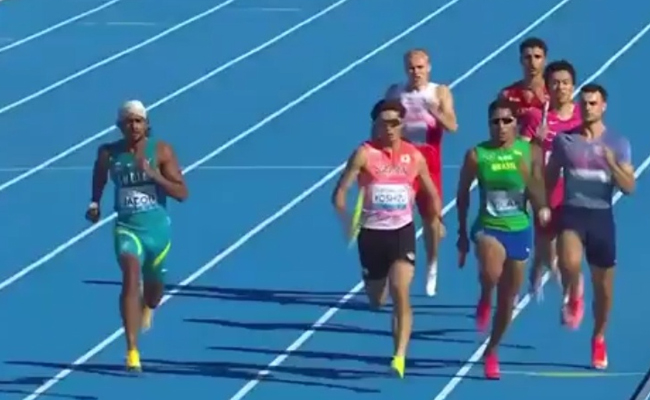
Gaborone (Botswana) (PTI): Amoj Jacob and Ragul Kumar got injured during the men's 4x400m and 4x100 races respectively as India ended their World Athletics Relays campaign in disappointment on the second day of competitions here on Sunday.
The Indian camp had high hopes of making the 2027 World Championships in the men's 4x400m relay but the team did not finish (DNF) the race as Jacob suffered cramps and pulled out of the race after taking the baton from the first leg runner Dharamveer Choudhary. Rajesh Ramesh and Vishal TK were to run in the third and fourth legs.
Those teams which could not qualify for the 2027 Beijing World Championships by reaching the final round of each of the six relay events on Saturday were given another chance in the second qualification round on Sunday.
The top two teams in each of the two heats (in all six relay events) booked the Beijing ticket on Sunday.
India will now have to try and qualify for the World Championships through the Top Lists of the World Athletics, which is a long and tedious process.
In the men's 4x100m race, third leg runner Ragul Kumar fell down the track after failing to hand over the baton inside the exchange zone to fourth leg runner Gurindervir Singh, which clearly showed the lack of coordination among the runners.
Harsh Santosh Raut and Animesh Kujur ran the first two legs.
The Indian quartet was disqualified and Kumar was seen being taken away from the Field of Play with the help of the volunteers.
It was a comedy of errors in the case of the women's 4x100m race, which saw the baton being dropped during an exchange between first leg runner Tamanna and second runner Nithya Gandhe, though the Indians finished the race in 53.09 seconds.
Gandhe started running quite a distance, but after realising that the baton was not in her hand, she turned and ran back to pick it up.
The only silver-lining for the Indian contingent was the national record time in the mixed 4x100m relay race, though the quartet of Ragul Kumar, Nithya Gandhe, Animesh Kujur and Sneha SS finished sixth in heat number two with a time of 41.35 seconds, bettering the previous national mark of 42.30 seconds set in March in Chandigarh.
The mixed 4x400m relay quartet of Theerthesh P Shetty, Kumari Saloni, Nihal William and Rashdeep Kaur ended at fifth in heat number one with a time of 3 minutes and 19.40 seconds.
On Saturday, all the five Indian relay teams had failed to make it to the respective final rounds and thus missed out on the 2027 World Championships berths.