No possibility of mid-term polls in Karnataka: Siddaramaiah
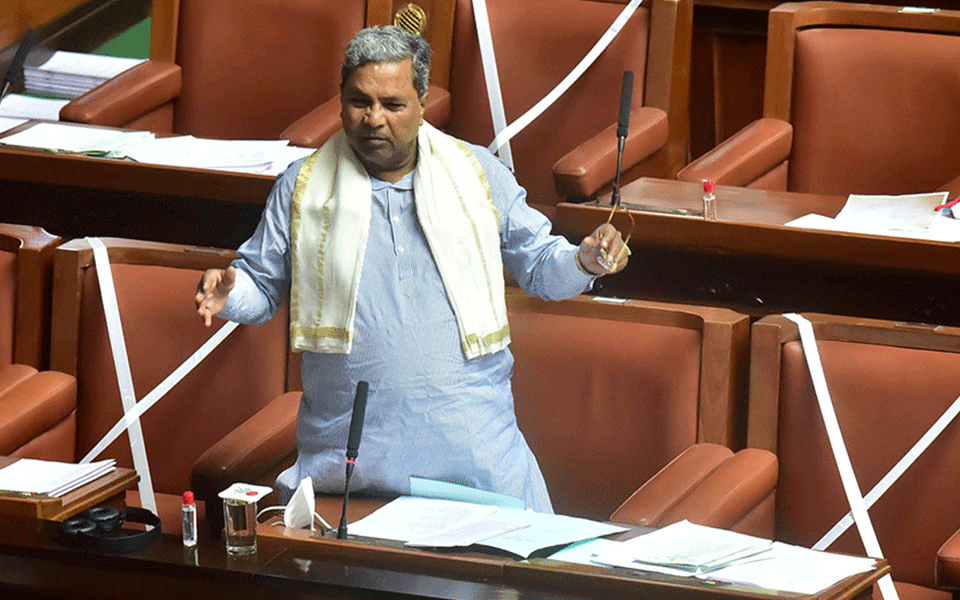
Bengaluru, Jun 24: The ruling Congress-JD(S) coalition coordination committee chief Siddaramaiah Monday ruled out any possibility of mid-term polls to the Karnataka assembly.
"No, there won't be any mid term poll," he told reporters in Mysuru, days after former prime minister and JD(S) supremo H D Deve Gowda had sent alarm bells ringing in the Congress after he spoke of such a possibility.
In a sign of growing tensions in the coalition, Gowda last Friday said he has no doubt that there would be mid-term polls to the state assembly, but had backtracked later, saying he had spoken about urban local bodies election.
Gowda had also said he did not know how long the government, headed by his son H D Kumaraswamy, would continue and it was in the hands of the Congress.
Hitting out at state BJP chief B S Yeddyurappa, Siddaramaiah said the former chief minister was"dreaming" about the collapse of the coalition government and him forming a ministry in the state.
"No one can respond to his (Yeddyurappa's) dreams (of forming government and becoming CM). He has been saying it for several times now. Whatever Yeddyurappa has said has not turned out to be true," he said.
Reacting to Siddaramaiah's comments in Bengaluru, Yeddyurappa said he was not dreaming of becoming chief minister as he has been in the post in the past.
"It is you (Siddaramaiah) who is dreaming about becoming chief minister once again and roaming, not me," he said, pointing at the clamour in Congress recently with some leaders seeking Siddaramaiah's return as chief minister again.
The clamour had caused resentment within the ruling coalition, with alliance partner JD(S) leaders and Kumaraswamy not happy about it.
Siddaramaiah and his supporters were forced to clarify that their demand was after the next assembly election.
Stating that the Karnataka Pradesh Congress Committee (KPCC) was dissolved to reorganize the party, Siddaramaiah, who is the Congress Legislature Party leader, said, "We will have new office bearers and it will be a mix of old, new, young and seniors."
In a major move after the rout in the Lok Sabha polls, the All India Congress Committee (AICC) on Wednesday said it has decided to dissolve the KPCC, while retaining its president and working president.
Siddaramaiah, who is in Mysuru, held a series of meetings with party workers and supporters there.
According to sources, the meeting was to discuss about Congress' defeat in Mysuru, Siddaramaiah's home district and Chamarajanagar, where he enjoys considerable influence, as the Varuna assembly segment, currently represented by his son Yatindra, comes under it.
The discussion was also on strengthening his support base in the region, which has deteriorated after Siddaramaiah lost from Chamundeshwari assembly segment during the May 2018 polls and rout in the Lok Sabha polls, the sources added.
The Congress and the Janata Dal (Secular) had to be content with one seat each in the Lok Sabha polls, which saw the Modi wave help the BJP bag 25 out of the total 28 seats in the state.
One seat was won by a BJP-backed Independent.
Let the Truth be known. If you read VB and like VB, please be a VB Supporter and Help us deliver the Truth to one and all.
Iran Shocks World, Hits F-35
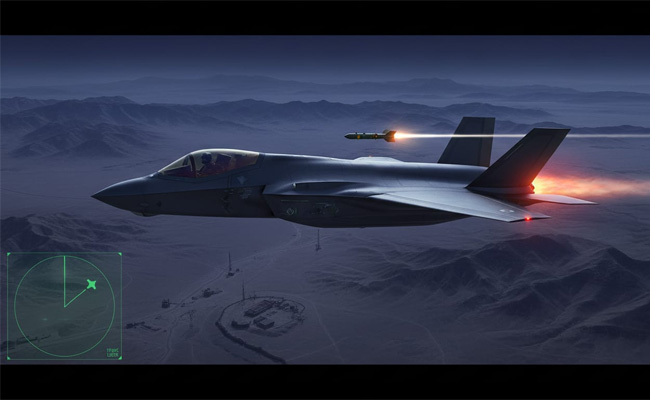
America's most advanced fighter jet, the F-35, was never hit in combat — not once, in its entire history. Countries spend over ₹900 crore to buy just one of these aircraft. The whole world believed this plane was untouchable. Then, on March 19, something happened over Iranian skies that shocked military experts across the globe.
Iran hit it. And nobody saw it coming.
America Was Too Confident — That Was the Problem
Before understanding how this happened, you need to understand what America believed going into this. The US had been bombing Iran since February 28. After roughly 20 days of heavy strikes, US Defence Secretary Pete Hegseth announced that Iran's air defences were completely destroyed — finished, flattened, gone.
US President Donald Trump even said proudly, "We can fly wherever we want, and no one is even firing at us."
Based on this confidence, America flew its prized F-35 deep into the heart of central Iran. That alone tells you how sure they were. You don't send your most expensive jet into enemy territory unless you believe there is zero danger.
But Iran, a country under heavy international sanctions, still had something left. And it used that something extremely well.
So How Did Iran Actually Hit a Stealth Jet?
Here is where it gets interesting for regular people to understand.
We have all heard the word "stealth" — it sounds like the plane is completely invisible. But India Today explained that stealth only means it is hard to detect by radar. Hard — not impossible. It does not mean the aircraft is totally invisible.
Think of it this way. Even if you cannot see someone in a dark room, you can still feel their body heat if they stand close enough. That is almost exactly what happened here.
The F-35's engines produce enormous heat. Iran's weapon likely used an infrared sensor — basically a heat-seeking system — to detect that heat, lock onto it, and follow the jet. No radar needed. The F-35's biggest advantage, its radar-invisibility, simply did not matter.
The weapon Iran likely used was the 358 missile — also called SA-67 — which is a loitering munition. Think of it as a slow, intelligent drone that flies around patiently waiting, scanning the sky for heat signals from aircraft engines. Once it finds one, it chases it down. Iran has used this exact weapon before against American MQ-9 Reaper drones — and since this war started, America has already lost more than 12 of those drones.
This Has Happened Before — In 1999
This is not the first time America's "invisible" aircraft was brought down by a smarter enemy.
In 1999, during NATO's bombing campaign over Serbia, the US flew its F-117 Nighthawk — which was then considered the world's most advanced stealth aircraft. Serbian forces shot it down using an old Soviet missile system from the 1960s. Not with new technology — with clever thinking. They briefly switched on their radar, caught the jet at the right moment when its stealth was less effective, and fired.
The lesson both then and now is the same — no aircraft is completely invincible. Smart tactics can beat expensive technology.
Why This Changes Everything in the Iran War
Here is the bigger picture that really matters.
America and Israel had told the world that Iran's air defences were basically dead. Based on that, they sent massive B-1 and B-2 bombers — aircraft that are normally used only when a country is 100% sure it controls the enemy's sky. That is a huge military risk to take.
But if an F-35 — the most advanced aircraft in the sky — can still be hit, then Iran's defences are clearly not dead. Some pieces are still very much alive and working.
This means the US and Israel may now be forced to completely rethink their war plan. Their jets may need to fly higher, use longer-range weapons, and spend far more time and money finding where Iran's remaining defence systems are hiding underground.
Around 15 countries use the F-35 today. Even India was offered this jet by Trump during PM Modi's White House visit — though India has not shown interest so far.
Geopolitical expert Adam summed it up simply — a heavily sanctioned country just tracked, chased, and hit the world's most expensive stealth jet. That is not a small thing.
Sometimes, one moment changes everything.
(Girish Linganna is an award-winning science communicator and a Defence, Aerospace & Geopolitical Analyst. He is the Managing Director of ADD Engineering Components India Pvt. Ltd., a subsidiary of ADD Engineering GmbH, Germany.)
Disclaimer: The views and opinions expressed in this article are solely those of the author. They do not necessarily reflect the views, policies, or position of the publication, its editors, or its management. The publication is not responsible for the accuracy of any information, statements, or opinions presented in this piece.
_vb_55.jpeg)