Rules say to 'decide now' on resignations, how can Speaker keep it pending: rebel MLAs to SC
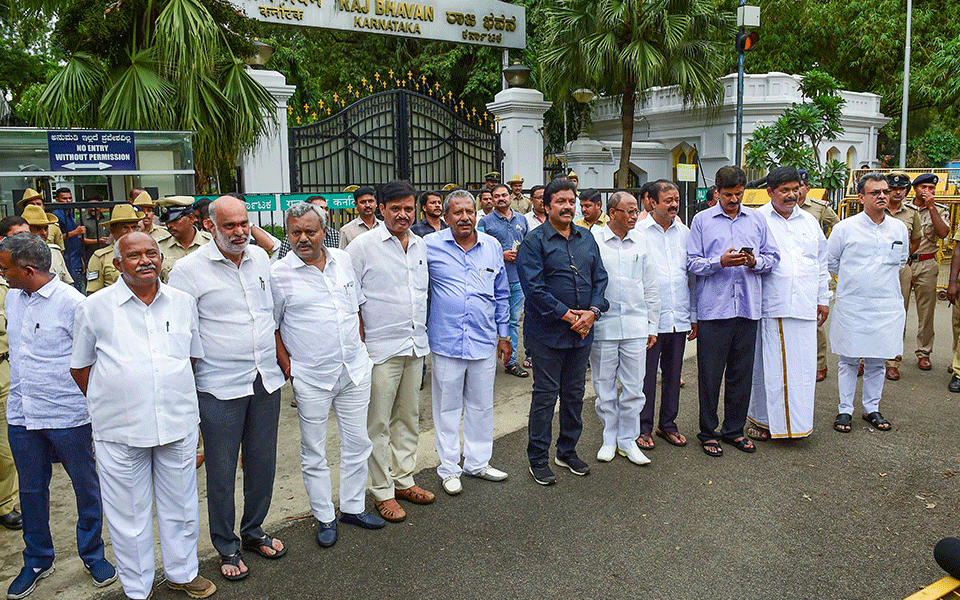
New Delhi, Jul 16: Ten rebel MLAs of Karnataka's ruling Congress-JD(S) coalition Tuesday said in the Supreme Court that rules mandate the Speaker to "decide now" on resignation and contended that by not accepting it he has attempted to coerce them to vote for the government during trust vote.
A bench headed by Chief Justice Ranjan Gogoi is first dealing with the case of 10 lawmakers who approached the court earlier.
The bench asked senior advocate Mukul Rohatgi, appearing for the rebel MLAs if there was any constitutional obligation on the Speaker to decide disqualification which was initiated after the resignation. Rohatgi said that the rules say to 'decide now' on resignation. "How can the Speaker keep it pending?" he asked.
The rebel MLAs told the court that the state government has been reduced to minority and the Speaker by not accepting their resignations has attempted coercing them to vote for the government in trust vote.
Disqualification proceeding is mini-trial under the Constitution's 10th Schedule, Rohatgi said, adding that resignation is different and its acceptance is based on single criterion it is voluntary or not.
There is nothing to show the rebel MLAs conspired with BJP, the senior advocate said.
The disqualification proceeding was nothing but to scuttle resignation of MLAs, he said.
He also told the court that the disqualification proceedings were initiated for not being a disciplined soldier of the party and for not attending meetings outside the House.
The bench further asked if all the disqualification pleas are on same grounds, to which Rohatgi replied "more or less same".
He had also told the court that the Speaker has to only see if the resignations were voluntary or not.
"Resignation has to be accepted, there is no other way to deal with it," Rohatgi told the court.
"It is my fundamental right to do whatever I want to do and cannot be bound due to non-acceptance of resignation by speaker," submitted Rohatgi.
There is vote of confidence in assembly and the rebel MLAs may be forced to follow whip despite resigning, he said.
Rohatgi told the court that the 10 MLAs resigned on July 6 and disqualification proceedings against two lawmakers were pending.
"When was the disqualification proceedings filed against rest eight MLAs," the top court asked, to which Rohatgi responded that disqualification proceedings started against them on July 10.
The 10 rebel MLAs moved the apex court alleging that the Speaker was not accepting their resignations.
They are: Pratap Gouda Patil, Ramesh Jarkiholi, Byrati Basavaraj, B C Patil, S T Somashekhar, Arbail Shivaram Hebbar, Mahesh Kumathalli, K Gopalaiah, A H Vishwanath and Narayana Gowda.
The apex court, which was dealing with the plea of 10 rebel MLAs on July 12, will now be hearing five more lawmakers who have sought identical relief that Karnataka Assembly Speaker K R Ramesh Kumar accept their resignations as well.
The five MLAs Anand Singh, K Sudhakar, N Nagaraj, Munirathna and Roshan Baig mentioned their application before a bench of Chief Justice Ranjan Gogoi and Justice Deepak Gupta Monday seeking impleadment as parties to the pending plea on which it was ordered that the speaker would not take any decision till Tuesday on the resignations and disqualifications.
The top court had on Friday restrained the Speaker from taking any decision till July 16 on the resignation and disqualification of the rebel MLAs.
The top court had said an incidental question that would arise in the matter is the kind and extent of the directions that should be issued by a constitutional court to another constitutional functionary, which in the present case happens to be the Speaker of the Assembly.
Let the Truth be known. If you read VB and like VB, please be a VB Supporter and Help us deliver the Truth to one and all.
India needs steady hand at the wheel but has 'compromised PM': Rahul
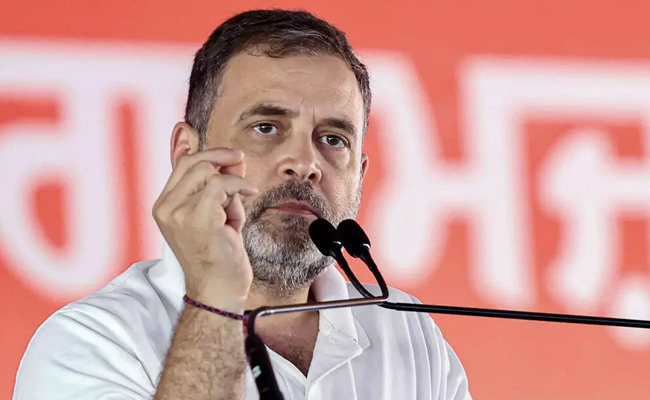
New Delhi (PTI): A day after a US submarine torpedoed and sank an Iranian warship in international waters off Sri Lanka's coast, the Congress on Thursday questioned the government's silence with Rahul Gandhi saying that while the country needed a steady hand at the wheel, it has a "compromised PM who has surrendered our strategic autonomy".
Congress president Mallikarjun Kharge said the Modi government's "reckless abdication" of India's strategic and national interests is there for all to see.
"An Iranian ship, a guest of India was returning, unarmed from the International Fleet Review 2026, hosted by us, and was torpedoed in the Indian Ocean Region (IOR). No statement of concern or condolence. PM Modi remains mute," Kharge said on X.
"Why lecture us on the doctrines of MAHASAGAR and India being a 'Net Security Provider' in the IOR, when you can’t react on what is happening in your own backyard? As many as 38 Indian Flag commercial ships along with 1100 sailors are stuck in Gulf of Hormuz," he said.
"Indian sailors, including Captain Ashish Kumar have reportedly died. Why is there no maritime rescue or relief operation in place? You say only 25 days of crude and oil stocks left. With rising oil prices, what is our energy contingency plan, especially in the wake of GOI virtually accepting the demand to stop import of Russian oil? What about the trade of other key commodities with the gulf countries?" the Congress chief said.
As per MEA statement on March 3, "some Indian nationals have lost their lives or are missing", he said.
"There are one crore Indians in the gulf region countries. Medical students are releasing desperate video messages seeking help. How is the GOI securing their well-being? Is there any evacuation plan in place from the affected areas?" Kharge said.
"Clearly, Modi Ji's SURRENDER is both political and moral! It demeans India’s core national interests and destroys our foreign policy carefully and painstakingly built and followed by successive governments over the years!" Kharge said.
Gandhi said the world has entered a volatile phase and "stormy seas lie ahead"
"India's oil supplies are under threat, with more than 40% of our imports transiting the Strait of Hormuz. The situation is even worse for LPG and LNG," he said on X.
"The conflict has reached our backyard, with an Iranian warship sunk in the Indian Ocean. Yet the Prime Minister has said nothing," Gandhi said.
At a moment like this, India needs a steady hand at the wheel, he said.
"Instead, India has a compromised PM who has surrendered our strategic autonomy," Gandhi alleged.
Congress general secretary in-charge communications Jairam Ramesh also said maybe it should not be surprising since the Modi government has still not broken its silence over the targeted assassinations in Iran.
In a significant escalation of the West Asia crisis, a US submarine on Wednesday torpedoed and sank an Iranian warship in international waters off Sri Lanka's coast when it was returning after participating in the Milan naval exercise, a multilateral wargame hosted by India.
In a post on X, Ramesh said the Indian Navy's flagship multilateral exercise, MILAN, was first held in 1995 and the 13th edition was held in Visakhapatnam from February 19 to February 25, 2026 with 18 warships from other countries, including the USA and Iran participating.
The exercise was inaugurated by Defence Minister Rajnath Singh, Ramesh pointed out.
"This makes yesterday's sinking of the Iranian warship that took part in the Milan exercise by a US Navy submarine in the Indian Ocean some 40 nautical miles south of Galle in Sri Lanka all the more extraordinary. The Iranian warship was on its way back home," he said.
This US action has enormous implications for India as well and it is shocking that there has been no official response to it till now, Ramesh said.
"Maybe it should not be surprising since the Modi government has still not broken its silence over the targeted assassinations in Iran. Never before has the Indian government looked so timid and fearful," the Congress leader said.
US Defence Secretary Pete Hegseth, confirming the strike, said at a Pentagon media briefing that it was the first sinking of an enemy warship by a torpedo since World War II.
The Associated Press, quoting the Sri Lankan Navy, reported that 87 bodies were recovered and that 32 people were rescued following the sinking of the warship IRIS Dena.
The incident marks a major escalation of the conflict between the US and Iran outside of the Persian Gulf and throws up questions relating to maritime security in the Indian Ocean that is largely considered as the backyard of the Indian Navy.
The US and Israel launched military strikes on Iran on February 28, killing Iranian Supreme Leader Ayatollah Ali Khamenei.
Following the military offensive, Iran has carried out a wave of attacks mainly targeting Israel and American military bases in several Gulf countries, including the UAE, Bahrain, Kuwait, Jordan and Saudi Arabia.
In the last few days, the conflict has widened significantly with attacks and counter-attacks by both sides.
India has called for resolving the conflict through dialogue and diplomacy.