Siddaramaiah urges PM Modi to suspend VB-G RamG Act, flags 'erosion' of employment rights
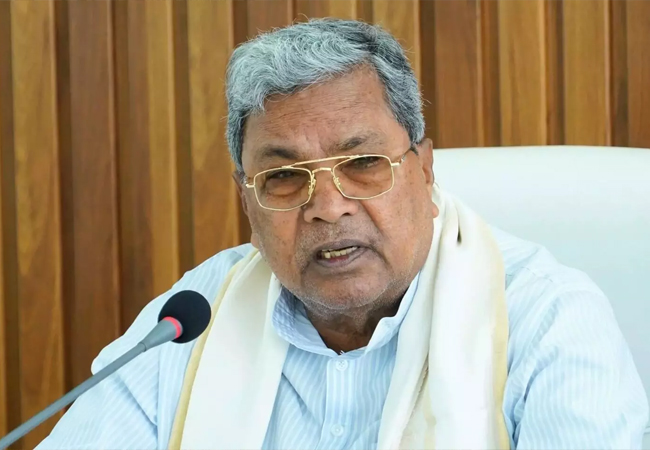
Bengaluru (PTI): Karnataka Chief Minister Siddaramaiah on Tuesday urged Prime Minister Narendra Modi to suspend the implementation of the Viksit Bharat–Guarantee for Rozgar and Ajeevika Mission (Gramin) (VB-G RamG) Act, warning that the new law fundamentally weakens the employment guarantee framework and undermines cooperative federalism.
In a detailed letter to Modi on Tuesday, the Chief Minister expressed serious concern over the repeal of the Mahatma Gandhi National Rural Employment Guarantee Act (MGNREGA), stating that the new legislation risks dismantling a demand-driven, rights-based entitlement that has served as a critical livelihood safety net for rural households.
“I wish to draw your kind attention to the Viksit Bharat-Guarantee for Rozgar and Ajeevika Mission (Gramin) (VB-G RamG) Act and the consequent repeal of the National Rural Employment Guarantee Act,” Siddaramaiah wrote, cautioning that the shift could defeat the very intent of an employment guarantee law.
“At the outset, I submit that the new law risks defeating the very intent of the original employment guarantee, a demand-driven, rights-based entitlement,” the Chief Minister said, while acknowledging that although the new Act increases the promised guarantee from 100 to 125 days, it does not provide assured planning or central funding to back that promise.
ALSO READ: Congress and NCP (SP) to contest separately in Nagpur civic polls
Siddaramaiah pointed out that the VB-G RamG Act caps the union government’s financial responsibility to a ‘normative allocation’ for notified areas of each state, with the Centre contributing only 60 per cent of that allocation in most states.
“As a result, the so-called legal guarantee of 125 days is not absolute,” he said, adding that it is constrained by a centrally determined funding ceiling, leaving many gram panchayats without funds despite genuine demand.
The Chief Minister also objected to provisions that allow the Centre to determine state-wise normative allocations annually based on objective parameters that are neither embedded in the legislation nor fixed through consultation.
He warned that such parameters could be altered unilaterally and would fail to reflect diverse local needs across and within states.
“In effect, a demand-driven regime is being converted into a supply-driven, top-down system,” Siddaramaiah wrote, pointing out that the new framework runs contrary to the participatory approach under MGNREGA, where labour budgets originate at the gram panchayat level and allocations follow village-level demand rather than central convergence plans.
He stated that this diluted the constitutional vision of decentralisation under the 73rd Amendment.
Raising alarm over the revised funding pattern, Siddaramaiah said under MGNREGA, mainstream states followed a 90:10 Centre-State sharing arrangement, while the new Act shifts this to 60:40.
This, he said, converted a statutory guarantee into “a run-of-the-mill scheme” and imposed a heavy burden on state finances already strained due to GST compensation issues and inequitable financial devolution.
According to him, the provision making states fully liable for expenditure beyond their normative allocation could leave them facing 100 per cent financial responsibility for excess demand.
In such a scenario, he said, the guarantee would depend not on demand but on a state’s fiscal capacity, rendering the entitlement unenforceable.
Siddaramaiah also criticised the requirement to pre-notify a 60-day no-work period during peak sowing and harvesting seasons.
ALSO READ: Congress and NCP (SP) to contest separately in Nagpur civic polls
While acknowledging increased agricultural activity during those months, he said a blanket restriction would hurt vulnerable groups who may not find adequate farm work.
He cautioned that this could reduce employment opportunities, suppress wages and worsen livelihood insecurity, leading to increased distress migration and reduced participation of women.
Summing up the changes, Siddaramaiah wrote that the new framework shifts the intent “from ‘right to work’ to ‘work only if permitted’,” and from year-round rural employment to restricted periods and locations.
He also voiced concern that increased reliance on technology and contractor-led projects could exclude the poorest, particularly Dalit and Adivasi communities.
Terming the implementation "arbitrary and hurried", the CM said the Act violates constitutional provisions requiring consultation with states and weakens the foundations of cooperative federalism.
Siddaramaiah also opposed the removal of Mahatma Gandhi’s name from the law, calling it a historic, globally acclaimed rights-based legislation rooted in Gram Swaraj and Antyodaya.
Let the Truth be known. If you read VB and like VB, please be a VB Supporter and Help us deliver the Truth to one and all.
UP: Petrol pump manager booked for denying fuel to ambulance; causing man's death

Ballia (UP) (PTI): Police on Saturday registered a case against a petrol pump manager in connection with the death of a 50-year-old man who allegedly could not be taken to hospital in time after a private ambulance was denied fuel.
The case has been filed against Ashok Kumar Bharti, manager of M/s Bhushan Service Station in Tengrahi village, under sections of the Essential Commodities Act, officials said.
According to police, the FIR was lodged following a complaint by Supply Inspector Indresh Kumar Tiwari. During the inquiry, the manager admitted that an ambulance had arrived at the petrol pump around 9.20 pm on April 22 seeking fuel, stating that it had run out of petrol. However, fuel was not provided, citing non-availability, officials said.
The ambulance allegedly remained stationed at the pump for about 15 minutes. However, records showed that the petrol pump had sufficient stock on that day, including 4,595 litres of motor spirit, 4,784 litres of high-speed diesel and 3,475 litres of premium petrol, indicating that fuel was available but not supplied, the FIR said.
District Magistrate Mangla Prasad Singh said an inquiry was conducted under the supervision of the Additional District Magistrate by a team comprising the Sub-Divisional Magistrate of Bairia and the District Supply Officer. Based on the findings, directions were issued to register a case.
Circle Officer (Bairia) Mohammad Fahim Qureshi said police have launched a probe and are searching for the accused manager.
Earlier, District Supply Officer Devmani Mishra had said that Chhatthu Sharma (50), a resident of Pandeypur village in Bairia tehsil, fell critically ill on the night of April 22. His family was taking him to the district hospital in a private ambulance when it ran out of fuel on the way.
The family approached a petrol pump near Tengrahi village for fuel, but the operator allegedly refused, citing a shortage. The family claimed that Sharma died on the way as he could not be taken to the hospital in time due to a lack of petrol.
The district magistrate said that CCTV footage confirmed that the ambulance had reached the petrol pump and sought fuel, which was not provided. He added that the pump operator cited low stock, but inspection revealed sufficient stock of petrol and diesel at the outlet.
Officials said that representatives of Indian Oil have also visited the site, and further action against the petrol pump will be recommended based on the findings.