Ten bills passed by Karnataka legislature pending for President's assent: Officials
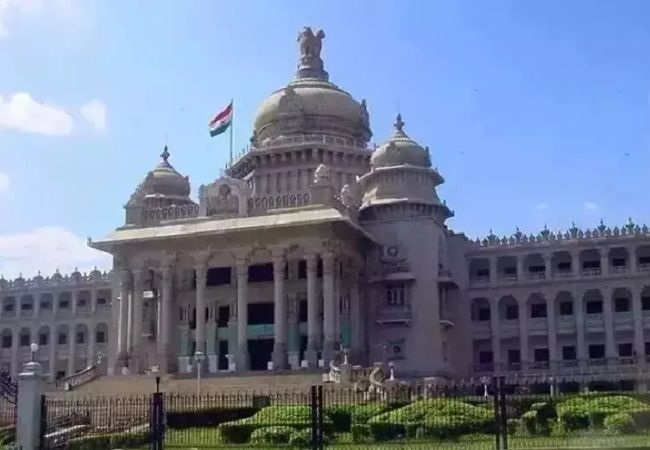
Bengaluru (PTI): At least 10 bills passed by the Karnataka legislature including one meant for providing four per cent reservation for Muslims in contracts in civil works are pending for Presidential assent, official sources here said on Thursday.
According to them, no bill is pending before the Kanrataka Governor for approval.
The number of Bills pending for the President and Governor gains significance in the backdrop of the Supreme Court on Thursday holding that the court cannot impose any timelines on the two to grant assent to Bills passed by state assemblies. At the same time, the SC said Governors do not have unfettered powers to sit on the Bills for "perpetuity".
In its unanimous opinion on the Presidential Reference, a five-judge Constitution bench headed by Chief Justice B R Gavai also held that "indefinite delay" by the Governors will be open to "limited judicial scrutiny" and that deemed assent of Bills cannot be granted by the apex court by using its plenary power under Article 142. Deemed assent would amount to virtual takeover of the role of a "separate constitutional authority," it said.
Among the bills from the state pending for the President's assent include The Karnataka Transparency in Public Procurements (Amendment) Bill, 2025. It provides for reserving for Muslims, four per cent of contracts in civil works valued up to Rs 2 crore, and goods/services contracts up to Rs 1 crore. It was referred to the centre in June 2025.
The Karnataka Hindu Religious Institutions and Charitable Endowment (Amendment) Bill, 2024, was referred to centre in June 2025. The Bill proposes to collect five per cent from temples whose gross income is between Rs 10 lakh and less than Rs one crore and 10 per cent from temples whose income is above Rs one crore, to be put into a Common Pool Fund, administered by 'Rajya Dharmika Parishath', which is proposed to be used for Archakas' (priests) welfare and upkeep of 'C' category temples (state controlled) whose annual income is less than Rs five lakh.
Also pending for President's approval are: the Karnataka Public Service Commission (Conduct of Business and Additional Functions) Bill, 2025, referred in July 2025; the Right of Children to Free and Compulsory Education (Karnataka Amendment) Bill, 2015, referred in May 2015; the Karnataka Mineral Rights and Mineral Bearing Lands) Tax Bill, 2024, referred in April 2025; the Registration (Karnataka Second Amendment) Bill, 2025, referred in September 2025.
The Prohibition of Child Marriage (Karnataka Amendment) Bill, 2025, referred in September 2025; the Karnataka Devadasi (Prevention, Prohibition, Relief and Rehabilitation) Bill, 2025, referred in September 2025; the Criminal Law Amendment Ordinance, 1944 (Karnataka Amendment) Bill, 2022, referred in March 2022; and the Notaries (Karnataka Amendment) Bill, 2025, referred in April 2025 also await Presidential assent.
The Right of Children to Free and Compulsory Education (Karnataka Amendment) Bill, that is pending since 2015, seeks to make the mother tongue or Kannada as the medium of instruction for Classes 1-5.
This bill was introduced after the Supreme Court in 2014 rejected Karnataka;s case and said that the government cannot "impose the mother tongue" in primary education.
Let the Truth be known. If you read VB and like VB, please be a VB Supporter and Help us deliver the Truth to one and all.
How Indian AI Is Booming with GEOX AI Leading the Next Wave of Geolocation Intelligence
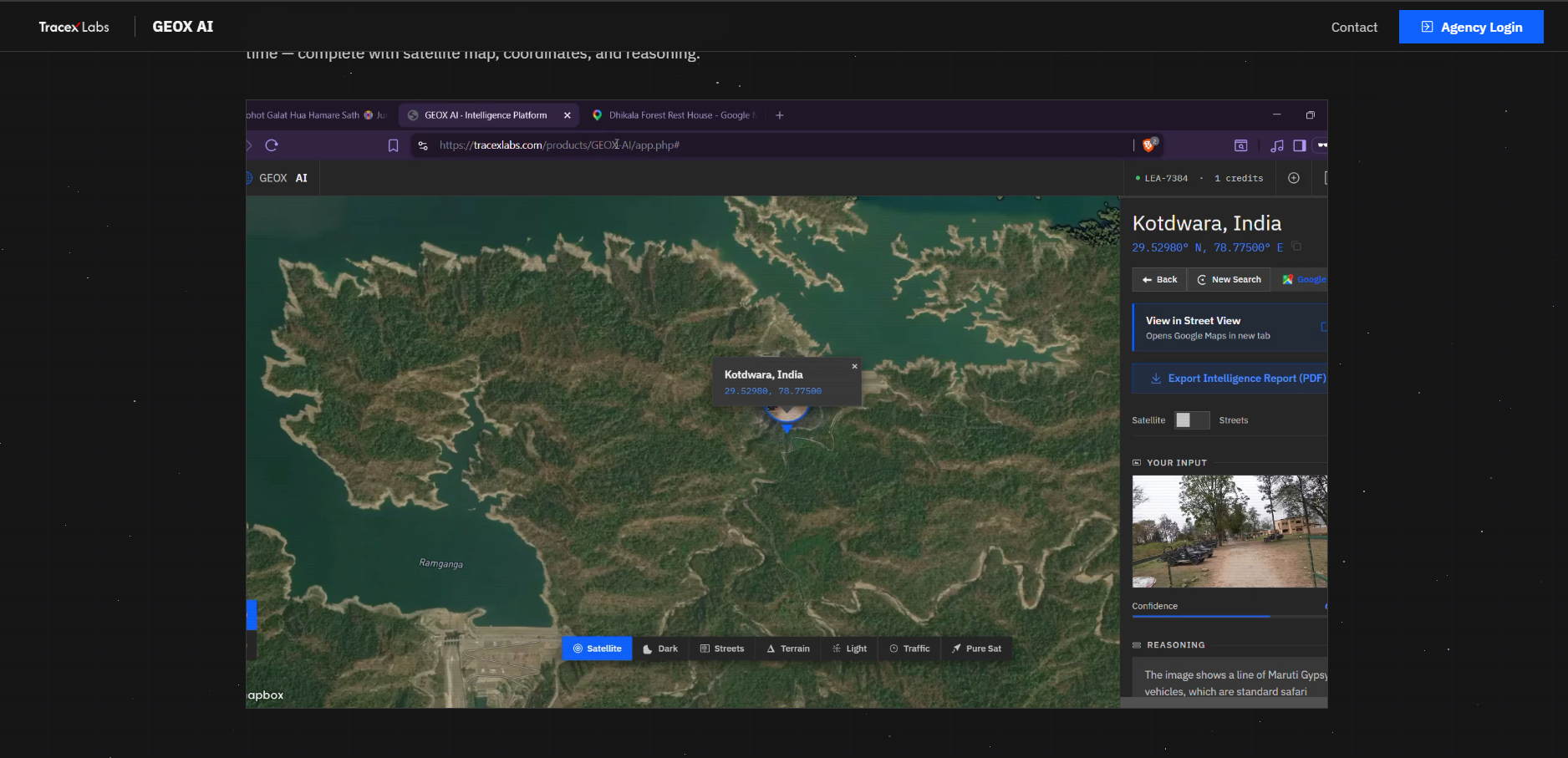
TraceX Labs has announced the launch of GEOX AI, an advanced artificial intelligence platform capable of identifying the real-world location where a photograph or video was taken using only the visual content within the media.
Positioned as an enterprise-grade intelligence solution, GEOX AI leverages advanced computer vision and multi-agent AI to analyze pixel-level details such as architecture, road patterns, vegetation, signage, lighting, and environmental context. By interpreting these visual clues, the system can estimate—and in many cases precisely determine—the origin of an image or video.
AI-Powered Geolocation Intelligence
Marketed under the concept of “Locate Anywhere From Any Image,” GEOX AI is designed for intelligence operations where speed, accuracy, and reliability are critical. The platform currently supports:
- 400+ analyses available
- <10 seconds average response time
- Up to 99% accuracy on landmark-based identification
- Global coverage across diverse terrains and environments
Core Capabilities
GEOX AI integrates multiple intelligence features into a single platform:
- Precise Geolocation:
Identifies exact geographic coordinates using visual landmarks, architecture, vegetation, and cultural indicators. - Satellite Map View:
Results are plotted on live satellite imagery with 2D/3D viewing options and multiple map styles for deeper analysis. - AI Reasoning Analysis:
Provides a detailed explanation of how the system arrived at a conclusion, including confidence scoring. - Multi-Result Analysis:
Returns multiple possible locations ranked by confidence, enabling cross-verification. - Intelligence PDF Export:
Allows one-click generation of professional reports containing maps, coordinates, analysis, and structured findings. - Credit-Based Access:
Agencies are allocated credits, with each analysis consuming one credit. Additional credits can be requested directly.
Speed Meets Intelligence
GEOX AI is designed to balance rapid processing with analytical depth:
- Fast Mode: Delivers results within seconds for clear and high-context images
- Advanced Mode: Performs deeper multi-step analysis for complex or ambiguous visuals
- Built for real-time decision-making in high-pressure environments
How GEOX AI Works
The platform follows a simple and efficient workflow:
- Upload any image or video frame
- AI analyzes visual clues such as structures, terrain, and environment
- The system identifies location with coordinates, confidence score, and reasoning
- Results are displayed on an interactive satellite map
- Export a professional intelligence report in one click
A Breakthrough for Investigations
GEOX AI is expected to have wide-ranging applications across multiple domains:
- Tracking the origin of images from social media and open sources
- Supporting digital forensics and cyber investigations
- Assisting law enforcement and intelligence operations
- Helping journalists and OSINT analysts verify visual content
- Providing support in missing person cases and threat intelligence scenarios
Enterprise Access and Deployment
GEOX AI is available to verified law enforcement agencies, intelligence organizations, and authorized enterprises. Access is provided through a structured system where organizations can request credentials and define their operational use cases.
Interested users can request access via tracexlabs.com or contact contact@tracexlabs.com, with response times typically within 24–48 hours.
Privacy Debate Intensifies
The launch of GEOX AI has also sparked renewed discussion around digital privacy. By demonstrating how location data can be extracted purely from visible elements within images, the platform highlights the potential risks associated with sharing photos online without considering what those visuals may reveal.
Conclusion
With GEOX AI, TraceX Labs is entering the rapidly evolving geolocation intelligence space with a platform that combines speed, precision, and real-world usability. As artificial intelligence continues to advance, tools like GEOX AI are expected to play a critical role in shaping the future of investigations, security, and digital intelligence.