Tipu Sultan is nation's asset: DK Shivakumar'
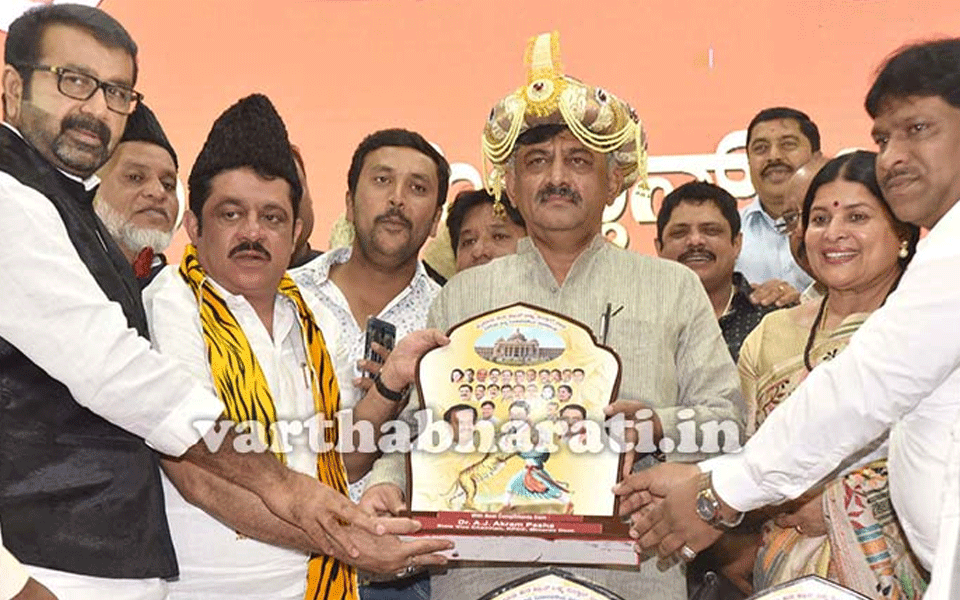
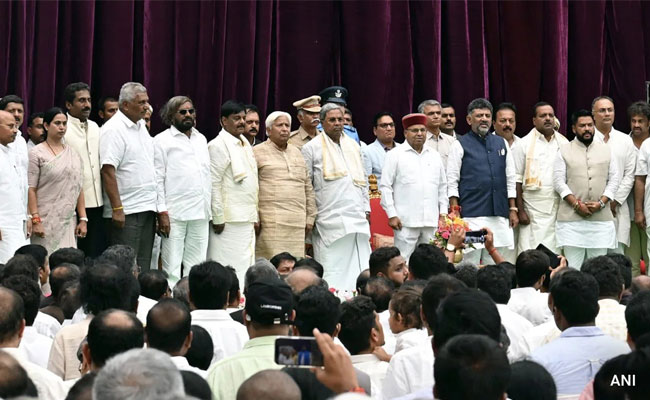
Bengaluru, November 10: Minister DK Shivakumar said that country’s first freedom fighter Tipu Sultan was not just the property of the state, but he was an asset of the country and it was the duty of the state to pay respect to him by celebrating his jayanti.
Inaugurating the Tipu Jayanti programme organized by the Kannada and Culture department at the Vidhana Soudha banquet hall here on Saturday, he said that being a brave soldier, Tipu had developed sericulture, horticulture, agriculture and other sectors to help the common people.
No politics in Tipu’s name
During the Diamond Jubilee celebration of Vidhana Soudha, President Ramnath Kovind had recalled Tipu’s contributions to the country. But the BJP leaders have been trying to disturb peace and harmony for their selfish politics, he alleged.
Poojas were being offered in the name of Tipu Sultan in Sri Ranganatha Temple at Srirangapatna, Nanjundeshwara temple at Nanjanagudu and other temples across the state every day. But despite having such instances, the BJP leaders have been conspiring to expose Tipu as anti-Hindus, he regretted.
Food and Civil Supplies department Minister Zameer Ahmed Khan said that Tipu jayanti was being celebrated since many years. But since four years, it was being celebrated as a government programme. BJP’s protest against Tipu jayanti was just for political reasons. The BJP has been trying to play communal card ahead of Lok Sabha elections by opposing the Tipu Jayanti. BJP state president B.S Yeddyurappa, leaders Jagadish Shettar, R. Ashok and others had participated in Tipu Jayanti programme and appreciated him. But now, when it was announced as the government programme, they have been opposing it. It was the habit of the BJP, he alleged.
Kannada and Culture Minister Dr. Jayamala said that at a time when the society was being divided in the name of caste and religions, the ideologies and principles of brave soldier Tipu Sultan who was known for his communal harmony, tolerance and public help, should be emulated.
Dr K Sadashiva of Mysore University said that Tipu Sultan had built the Mysore state as a ‘welfare state’ through his pro-people works like distribution of lands to the exploited classes, construction of tanks and introducing various reforms. In his army, people given place in his army based on eligibility irrespective of castes and creeds. He has fixed a monthly salary for the soldiers to help their families. He had created an environment where women were living without fear, he recalled.
MLA R. Roshan Baig presided over the programme in which Shanti Nagar MLA NA Haris, MLC Rizwan Arshad, Karnataka Urdu Academy president Mubeen Munavvar, Ameer-a-Shariat Hazrat Maulana Sageer Ahmed Khan Saheb Rashadi and others were present.
“Unnecessary confusion is created on the absence of Chief Minister H.D Kumaraswamy from the Tipu Sultan Jayanti programme. But the CM was taking rest as per the doctors’ advice. So, his name was not mentioned in the invitation card. But he has sent a message on the Tippu Jayanti”.
- Zameer Ahmed Khan, Food and Civil Supplies Minister


Let the Truth be known. If you read VB and like VB, please be a VB Supporter and Help us deliver the Truth to one and all.
Punjab CM Mann meets President Murmu, seeks cancellation of membership of 6 RS members
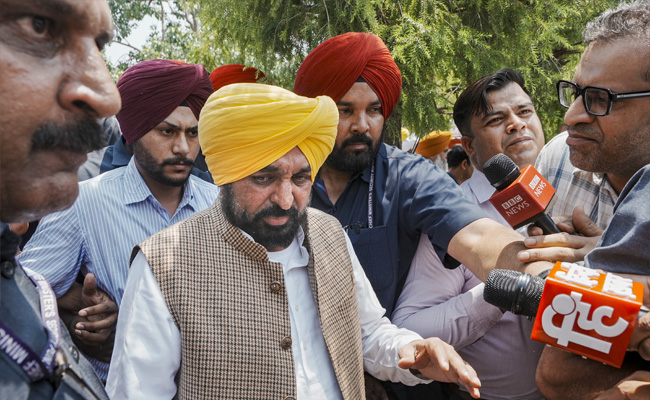
Chandigarh (PTI): Chief Minister Bhagwant Mann on Tuesday met President Droupadi Murmu, demanding the termination of the membership of six Rajya Sabha MPs from Punjab who defected to the BJP and also pressed for the introduction of a constitutional provision allowing for the recall of members.
Accompanied by party MLAs and ministers, Mann visited Rashtrapati Bhavan in Delhi.
This meeting followed a significant setback for the Aam Aadmi Party (AAP) on April 24, when seven of its 10 Rajya Sabha MPs -- Raghav Chadha, Ashok Mittal, Sandeep Pathak, Harbhajan Singh, Rajendra Gupta, Vikramjit Sahney and Swati Maliwal -- quit and merged with the BJP, alleging that the party had strayed from its principles, values and core morals. Six of the seven MPs who left AAP hailed from Punjab.
After he met with the President, Mann addressed the media here, describing the departure of the seven MPs as a "murder" of the Constitution. He stated, "Seven MPs merging with another party is completely unconstitutional. I spoke to Rashtrapati ji in detail."
Mann pointed out that he told the President that the BJP holds only two MLA seats (in Punjab), yet now has six MPs in the Rajya Sabha. He questioned, "How can this be possible? Isn't it a mockery of the Constitution?
"If they are such revolutionaries at heart, then they should have resigned from their six seats. The AAP could have sent someone else," Mann said, taking a swipe at them.
He emphasised the need for a recall provision in the Constitution, referencing MP Raghav Chadha's previous demands for such a measure when members fail to meet public expectations.
"Have you lived up to the expectations of the people?" Mann challenged the MPs during his statement.
Mann also presented a letter to the President, signed by all AAP MLAs. He differentiated between the terms 'elected' and 'selected,' stating, "They were 'selected.' Therefore, their membership should be cancelled."
The President assured Mann that she would consult constitutional experts before responding.
Earlier in the day, Mann, along with party MLAs, departed for Delhi from Chandigarh.
Speaking to reporters in Chandigarh, Mann affirmed that all AAP MLAs stand united with the party. "Only I have been given time for the meeting," Mann said.
"The President is the guardian of the Constitution. She is the constitutional head of the country," he added.
Later in a post on X in Hindi, Mann said, "Our struggle to protect Punjab's rights and interests continues. Today, along with all AAP MLAs, I have left to discuss Punjab's burning issues and present the state's strong voice before the President.
As your public servant, our government remains fully committed to Punjab's prosperity and the safeguarding of the rights of every section of society."
The MLAs and ministers gathered at the chief minister's residence in the morning before heading to Delhi, carrying placards that read 'Punjab Mann De Naal' and 'Punjab's Traitors.'
The legislators left for Delhi in buses.
Mann had previously sought an appointment with the President to meet with party MLAs and demand the "recall" of the Rajya Sabha MPs who defected to the BJP. However, only Mann was given a time slot for the meeting.