'Childhood lead exposure not linked to adult criminal behaviour'

New York: Dispelling previous findings, a new study has said that children exposed to lead at a young age are less likely to be involved in criminal practices later in adulthood.
Responses toward lead exposure should focus on health consequences, and not potential criminal consequences, the study suggested.
Lead is a neurotoxin with well-documented effects on health.
Previous studies detected associations between childhood blood lead level and criminal offending owing to the toxic effect of lead disproportionately affecting people with low socioeconomic status.
However, the new study weakens association between lead exposure and adult criminal behaviour, the researchers said.
"There is no clear association between higher childhood blood lead levels and a greater risk for criminal behaviour (a dose-response relationship) in settings where blood lead levels are similar across low and high socioeconomic status," said Amber L. Beckley, from the Duke University, in North Carolina.
For the study, detailed in the journal JAMA Pediatrics, the team involved 553 individuals from New Zealand, whose blood lead levels were measured at age 11.
There cumulative criminal conviction, self-reported criminal offending, recidivism (repeat conviction), and violence were followed up to age 38.
The researchers removed low socioeconomic status as a factor because high blood lead levels were observed among children from all socioeconomic groups.
The results showed that childhood lead exposure was weakly associated with conviction and self-reported criminal offending up to age 38.
Further, lead exposure was also not associated with recidivism or violence.
Let the Truth be known. If you read VB and like VB, please be a VB Supporter and Help us deliver the Truth to one and all.
Allahabad HC orders probe into 'reinstatement' of teacher in UP's Barabanki
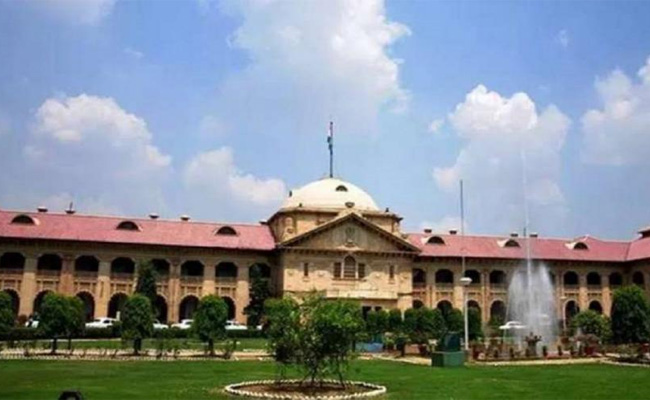
Lucknow (PTI): The Lucknow Bench of the Allahabad High Court on Friday ordered a probe by the special task force (STF) into alleged irregularities in the rejoining of a teacher at City Intermediate College in Barabanki, observing that the reinstatement appeared to be prima facie illegal.
The court also directed the recovery of the salary paid to the teacher during the disputed period.
A bench of Justice Rajeev Singh passed the order on a petition filed by the college management committee. The court expressed doubts over the roles of the District Inspector of Schools (DIOS), Barabanki, the college principal and the teacher concerned and hence, directed a detailed inquiry into the matter.
Taking note of alleged manipulation of records and misleading submissions, the court ordered the immediate transfer of the Barabanki DIOS to ensure a fair probe. It also directed the initiation of disciplinary proceedings against the then joint director of education of the Ayodhya division.
In its order, the court found that the teacher, Abhay Kumar, was initially appointed as an assistant teacher in 2018 but joined an Eklavya Model Residential School in Chhattisgarh as a lecturer in June 2024 without obtaining permission from the management. His subsequent request to retain the lien was rejected.
Despite this, he was allowed to rejoin the Barabanki College in September 2025 on the directions of the joint director of education and the DIOS, and was even paid the salary for October 2025. The court termed the rejoining "wholly illegal" and lacking any legal basis.
The bench also expressed concern over lapses in communication within the education department and directed the Uttar Pradesh chief secretary to ensure that official orders are communicated through email and WhatsApp as well, to prevent disputes.
The matter is next listed for hearing on May 28 when a compliance report is sought.