No element in Bajrang Dal's content that necessitates ban: Facebook India head Ajit Mohan

New Delhi, Dec 16: Facebook's India head Ajit Mohan deposed before a parliamentary panel on Wednesday and suggested that the social media company's fact-checking team has so far found no such element that necessitates a ban on the Bajrang Dal, sources said.
Mohan deposed before the Parliamentary Standing Committee on Information Technology, chaired by Congress leader Shashi Tharoor. The panel had called him on the issue of the citizens' data safety.
Mohan was accompanied by Shivnath Thukral, the public policy director of Facebook.
Congress MP Karti Chidambaram, along with Tharoor, questioned Mohan about a recent Wall Street Journal (WSJ) report suggesting that the social media giant is reluctant on banning the Bajrang Dal on its platform due to financial reasons and concerns over the safety of its staff, sources said.
The WSJ report suggested that despite an internal assessment calling for a ban on the Bajrang Dal, Facebook has not cracked down on the Hindu nationalist group due to these reasons.
Replying to queries, Mohan suggested to the panel members that the Facebook fact team consultant has so far not found any such element in the content posted by the Bajrang Dal that is violative of its social media policies.
Further quizzing him, BJP MP Nishikant Dubey asked if the Bajrang Dal content was not found to be violative of its social media policies, then why did the Facebook not deny the WSJ report and termed it as fake.
ALSO READ---FB India under Ankhi Das went soft on militant Hindu outfit Bajrang Dal to save business: WSJ report
Let the Truth be known. If you read VB and like VB, please be a VB Supporter and Help us deliver the Truth to one and all.
Ordinance issued to increase number of Supreme Court judges from 34 to 38
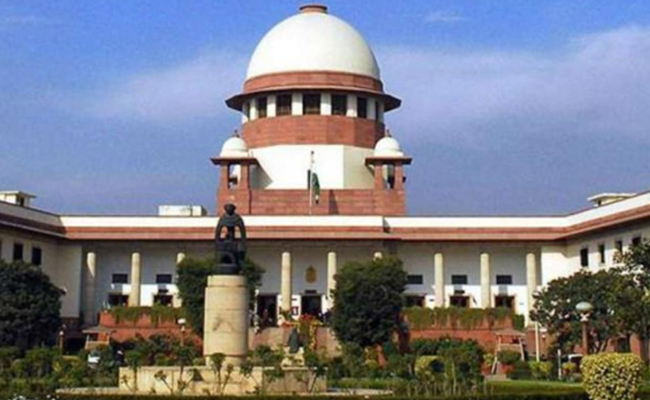
New Delhi (PTI): The government has promulgated an ordinance to increase the strength of the Supreme Court from the present 34 judges to 38, including the Chief Justice of India.
The law ministry notified the ordinance on Saturday, which amended the Supreme Court (Number of Judges) Act, 1956, to increase the sanctioned strength of the top court.
So far, the sanctioned strength of the top court was 34, including the Chief Justice of India (CJI). Now, the number of judges has been increased by four, taking the sanctioned strength to 38.
The top court will now have 37 judges, other than the CJI.
With the apex court having two vacancies at present, and the ordinance coming into force immediately, the Supreme Court Collegium will now have to recommend six names for appointment as judges in the top court.
A bill will be brought in the Monsoon Session of Parliament to convert the ordinance – an executive order – into a law passed by Parliament.
The Union Cabinet had cleared a draft bill on May 5 to increase the number of apex court judges.
The strength of the Supreme Court was last increased from 30 to 33 (excluding the CJI) in 2019.
The Supreme Court (Number of Judges) Act, as originally enacted in 1956, put the maximum number of judges (excluding the CJI) at 10.
This number was increased to 13 by the Supreme Court (Number of Judges), Amendment Act, 1960, and to 17 by another amendment to the law.
The Supreme Court (Number of Judges) Amendment Act, 1986, augmented the strength of judges from 17 to 25, excluding the CJI.
A fresh amendment in 2009 further increased the strength from 25 to 30.
Article 124(3) of the Constitution lists the qualifications required to become a Supreme Court judge.
An Indian citizen who has either served as a high court judge for at least five years, or as an advocate for 10 years, or is a distinguished jurist, can be appointed to the top court.
The strength of the Supreme Court is increased based on the recommendations of the CJI, who writes to the Union law minister. After consulting the finance ministry, the Department of Justice under the law ministry moves the Cabinet with a draft bill.