Hardik Pandya named captain of T20I squad vs Lanka; Rohit Sharma returns as captain in ODIs
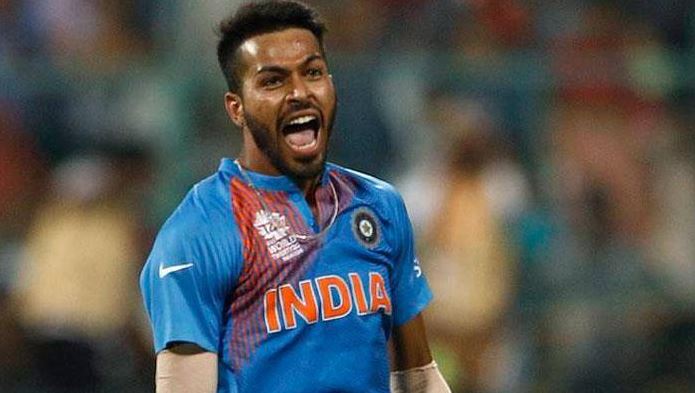
New Delhi, Dec 27: The transition phase in Indian cricket kick-started on Tuesday with premier all-rounder Hardik Pandya being named captain of the T20 side for the upcoming series against Sri Lanka starting January 3.
The 27-year-old Baroda man has also been named as the vice-captain of the ODI squad, indicating current regime's plans to see him as long-term white ball leader once 35-year-old Rohit Sharma decides to call time on his illustrious international career.
While Rohit, recuperating from a finger injury was named captain of the ODI series which is to follow the T20Is, it is understandable that the shortest format will now feature fresh faces and primarily IPL performers.
Even Virat Kohli and KL Rahul are also not part of the T20I format and there is an indication that the duo along with Rohit might not be picked again keeping the 2024 T20 World Cup in mind.
The troika will probably be asked to concentrate on 50-over format with a World Cup set to be played in India next year.
"Yes, there will be no official announcement that Rohit has been removed from T20I captaincy but he along with Kohli and Rahul will be phased out from the format. Obviously, Rohit's dislocated thumb injury hasn't completely healed although he has started training. But phasing out has indeed started," a senior BCCI source privy to development told PTI on condition of anonymity.
Suryakumar Yadav, for his mindblowing one year, is now the new vice-captain in T20Is.
Pandya, who led Gujarat Titans to IPL triumph during the last edition was touted as Rohit's replacement after India lost to England in the semi-finals of the T20 World Cup playing archaic cricket.
While Rohit is still recovering from thumb dislocation, the BCCI press release doesn't state if it is a permanent change or just for one series.
The T20I team has a fresh look with two uncapped pacers Shivam Mavi and Mukesh Kumar being inducted into the shortest format.
Mavi was picked by Titans for Rs 6 crore, while Bengal's Mukesh was snapped by Delhi Capitals for Rs 5.50 crore.
Ruturaj Gaikwad and Rahul Tripathi, two powerhouse IPL performers, made it to the T20 side.
The ODI side boasts of a more experienced look with Mohammed Shami coming back from shoulder injury.
Pant heads for NCA
Rishabh Pant is not a part of both the white-ball squads and it is understood that he has been asked to report at the NCA for a knee strengthening rehabilitation programme for two weeks. Hence, he will miss the entire Sri Lanka series.
But BCCI's statement doesn't mention whether he has been rested or dropped.
End of road for Shikhar Dhawan
Shikhar Dhawan, one of India's contemporary white ball greats, has perhaps played his last match for the country after a prolonged bad patch which finds him ousted from the national ODI set-up.
Ironically, even one series before Bangladesh, he was leading the side in New Zealand but his dismal drop in scoring rate and also not being able to string a series of consistent scores have gone against him.
Rohit being a white-ball giant and Shubman Gill in prime ODI form with Ishan Kishan hitting fastest double hundred less than a month back, India have multiple options and can look beyond Dhawan.
As reported by PTI on December 11, Dhawan has now been predictably dropped and possibly it is the end of the road for one India's star performers at the 2013 ICC Champions Trophy and 2015 World Cup, where he was the highest scorer.
India's squad for Sri Lanka T20Is: Hardik Pandya (Captain), Ishan Kishan (WK), Ruturaj Gaikwad, Shubman Gill, Suryakumar Yadav (VC), Deepak Hooda, Rahul Tripathi, Sanju Samson, Washington Sundar, Yuzvendra Chahal, Axar Patel, Arshdeep Singh, Harshal Patel, Umran Malik, Shivam Mavi, Mukesh Kumar.
ODI Squad: Rohit Sharma (Captain), Shubman Gill, Virat Kohli, Suryakumar Yadav, Shreyas Iyer, KL Rahul (WK), Ishan Kishan (WK), Hardik Pandya (VC), Washington Sundar, Yuzvendra Chahal, Kuldeep Yadav, Axar Patel, Mohd. Shami, Mohd. Siraj, Umran Malik, Arshdeep Singh.
Let the Truth be known. If you read VB and like VB, please be a VB Supporter and Help us deliver the Truth to one and all.
Explosive device kills 13, injures 38 on bus in southwestern Colombia as violence persists
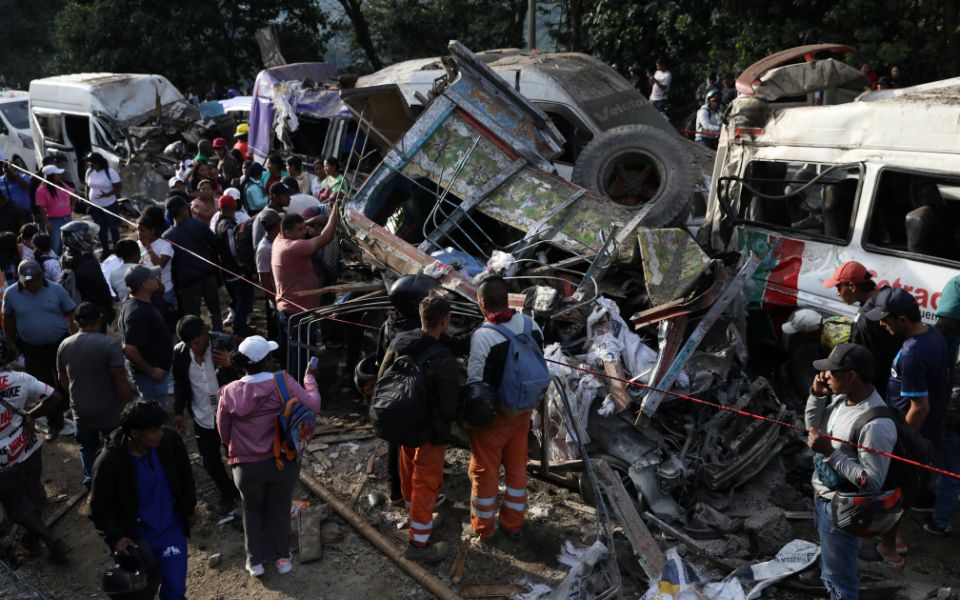
Bogota (Colombia) (PTI): An explosive device killed 13 people travelling on a bus in southwestern Colombia on Saturday, an attack the country's army chief described as a “terrorist act" that also left at least 38 injured as violence linked to drug trafficking in the region escalates.
Octavio Guzman, the governor of the region of Cauca, said on X that the device was set off while the bus was travelling along the Panamerican Highway in the municipality of Cajibio. Five children were among the injured, Cauca Health Secretary Carolina Camargo told Noticias Caracol, a TV news program.
Gen. Hugo Lopez, commander of Colombia's Armed Forces, told a news conference that it was a “terrorist act" and blamed the network of a man known as “Ivan Mordisco” — one of Colombia's most wanted figures — and the Jaime Martínez faction. Both are dissidents of the now-defunct Revolutionary Armed Forces of Colombia that operate in the region.
Neither Ivan Mordisco nor the Jaime Martínez faction abide by the peace agreement signed with the state in 2016.
Colombian President Gustavo Petro condemned the attack on X.
“Those who carried out the attack and killed seven civilians — and wounded 17 others — in Cajibío — many of them Indigenous people — are terrorists, fascists, and drug traffickers,” he wrote.
The attack is the latest in a spate of explosions that have attempted to target public infrastructure. At least 26 incidents have taken place in the past two days in southwestern Colombia, which Lopez said have only affected civilians.
They included a shooting at a police station in the rural area of Jamundi, and an attack on a Civil Aviation radar facility in El Tambo, where authorities took down three explosives-laden drones earlier on Saturday. No one was hurt.
On Friday, two vehicles rigged with explosives were detonated near military units in Cali and Palmira, causing material damage.
The escalation of violence in that region — a territory contested by illegal armed groups linked to drug trafficking — prompted the mobilisation of high-ranking officials on Saturday. Led by Defence Minister Pedro Sanchez, the delegation that includes regional governors and local authorities, was meeting in Palmira when the deadly explosion occurred.
“These criminals seek to instil fear, but we will respond with firmness,” Sanchez said on X.
Meanwhile, Francisca Toro, governor of Valle del Cauca, has called upon the national government to provide “immediate support.” In a message on X, Toro called for a reinforcement of public security forces, enhanced intelligence operations and “decisive actions” against crime in the face of a “terrorist-level escalation.”
According to authorities, Cauca and Valle del Cauca serve as a critical hub for illicit activities of illegal armed groups vying for control over sea and river access routes leading to the port of Buenaventura — a key transit point used to traffic drugs to Central America and Europe.
The government has also offered a reward of more than 1 million dollars for information leading to the capture of “Marlon,” who is identified as the leader of the region's dissident group. On Friday, local authorities offered more than USD 14,000 for information leading to the identification and location of those behind the attacks in Cali and Palmira.