Indonesian Masters: HS Prannoy to lead Indian charge after Satwik-Chirag pulls out
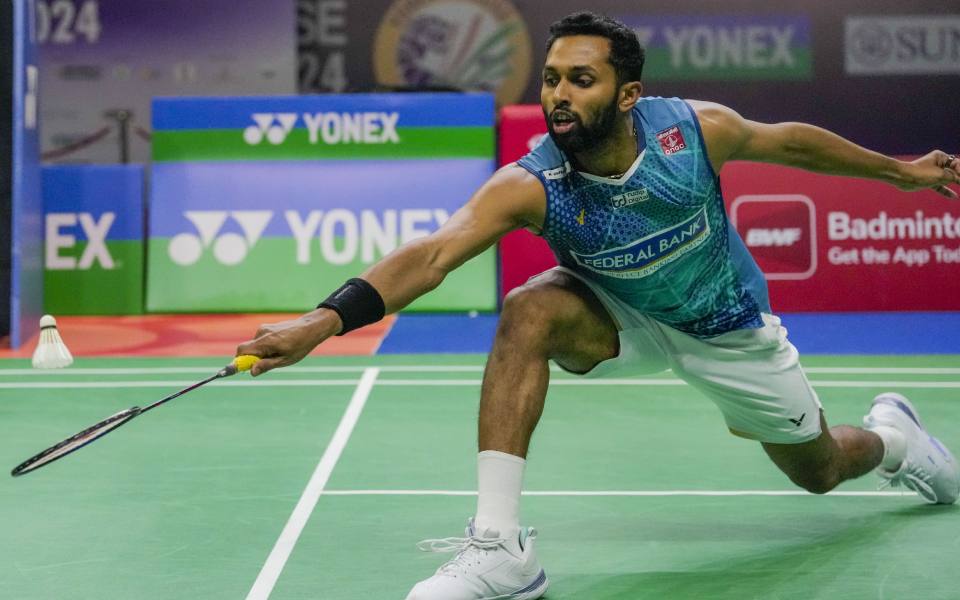
Jakarta, Jan 22: Singles ace HS Prannoy will spearhead the Indian challenge at the Indonesian Masters Super 500 badminton tournament beginning here on Tuesday after the pull-out of crack doubles pair of Satwiksairaj Ran kireddy and Chirag Shetty.
Having finished runners-up in back-to-back tournaments of Malaysia Super 1000 and India Open Super 750, the reigning Asian Games champions have given the tournament a miss with an eye on their workload with a gruelling season ahead of them.
The duo's absence may have taken some sheen of the tournament, but world No. 9 Prannoy will look to keep the Indian flag high continuing his consistent run.
Prannoy is only seeded Indian player at No. 7 in the men's singles draw of 32 as he will begin his campaign against Loh Kean Yew of Singapore, against whom the Indian has a 4-1 win-loss record.
The world No. 11 Yew's solitary win against Prannoy was at the 2021 World Championships and since then the Indian has won twice in a row with the last coming in bronze-medal winning run at the last year's World Championship.
Besides the that coveted bronze medal, Prannoy won the Malaysia Masters and finished second in the Australian Open last year.
He has been at his consistent best and had a last-four after being ousted by eventual champion Yu Qi Shi of China in the Indian Open last week.
Before that, Prannoy made an opening round exit in the Malaysia Open Super 1000.
The other Indian, who will be in focus will be world No. 19 Lakshya Sen, looking to end his opening round jinx, when he is up against Weng Hong Yang of China.
The world No. 16 Chinese has a 3-2 win-loss ratio against the young Indian and goes into the match on the back of his Malaysia Open win less than two weeks back.
Since his Canada Open triumph last year, Sen has been on a downward spiral and has capped eight opening round exits in a row.
Last week, Sen lost to his Indian teammate Priyanshu Rajawat in the Indian Open as the former World No 8 will look to find his mojo.
World Bo. 25 Kidambi Srikanth is also in fray and will face Lee Zii Jia of Malaysia, while 30th ranked Rajawat will be up against Rasmus Gemke of Denmark.
In Chirag and Satwik's absence, MR Arjun and Dhruv Kapila will be the lone Indians in fray in men's doubles as they will be up against Malaysia's Goh Sze Fei and Nur Izzuddin in the opening round.
No Indians will be fray in the women's doubles and mixed doubles events.
Let the Truth be known. If you read VB and like VB, please be a VB Supporter and Help us deliver the Truth to one and all.
T'gana RTC strike: Talks between govt, employees successful

Hyderabad (PTI): Talks between employees of Telangana State Road Transport Corporation (RTC) who were on strike and the state government concluded successfully on Friday as the government agreed to the key demands of the workmen.
Following a day-long marathon of talks between the leaders of the employees' Joint Action Committee (JAC) and the cabinet sub-committee, the government announced after midnight that it acceded to the demands, including a merger of RTC with the government, 11 per cent pay revision and elections to the employees' unions.
A committee comprising officials and employee leaders would be appointed over the merger of RTC with the government, it said.
The RTC management has also agreed to address the remaining issues as well, an official release said.
The employees would call off their strike and the RTC buses would hit the roads shortly, it said.
The employees had been on an indefinite strike since April 22 over a series of demands, including the merger of RTC with the government.
Earlier in the day, a driver of the RTC, who attempted suicide on April 23 during the strike, died at a hospital here in the early hours of Friday.
Shankar Goud, a 55-year-old driver, set himself ablaze by pouring petrol at Narsampet in Warangal district when the employees were staging a protest on Thursday in support of their demands.
Goud suffered serious burns, was initially admitted to a state-run hospital in Warangal, and later shifted to a super-speciality hospital in Hyderabad for advanced treatment.
"He succumbed (to injuries) at about 1.30 am on Friday," a senior official said.
The driver’s body was taken to his relative’s village, Muttojipet in Warangal district, for funeral rites.
Tension prevailed in Muttojipet as his family members and RTC employees attempted to take the body to the Narsampet bus station, where he worked, to enable his colleagues to pay their last respects. However, police did not permit this, citing law-and-order concerns.
This led to a deadlock before the funeral could proceed.
Union Minister Bandi Sanjay Kumar criticised the Telangana government for not allowing the body to be taken to the Narsampet bus station.
Kumar, Minister of State (Home), visited Muttojipet village in Warangal district, where the funeral was held, and paid homage to Goud.
“They (family members) want to take the body to the bus depot for five minutes. Is the RTC bus depot in Pakistan or Bangladesh? They are emotionally attached to taking the body there. The government is hurting sentiments and creating fear among RTC employees,” Kumar told reporters.
He also expressed anger at the police for not allowing the body to be taken to the bus station and staged a protest, according to a release from his office.
RTC employees and BJP workers attempted to take the mortal remains in an ambulance to Narsampet, but were stopped by the police.
Later, after discussions with the police, the family members and RTC employees agreed to conduct the funeral in the village.
Sanjay Kumar, stating he would abide by the family’s decision, left the village after the funeral was conducted there.
Transport Minister Ponnam Prabhakar said an ex gratia of Rs 10 lakh, a house, and a government job would be provided to the kin of Goud.
Chief Minister A Revanth Reddy expressed shock over the employee’s death and conveyed deep condolences to the grieving family, according to the release.
The RTC employees’ JAC had earlier announced an agitation programme from April 24 to 29, including silent marches and submission of memorandums to MLAs and other leaders.