SC asks Sreesanth why he didn't inform BCCI about being approached for spot-fixing
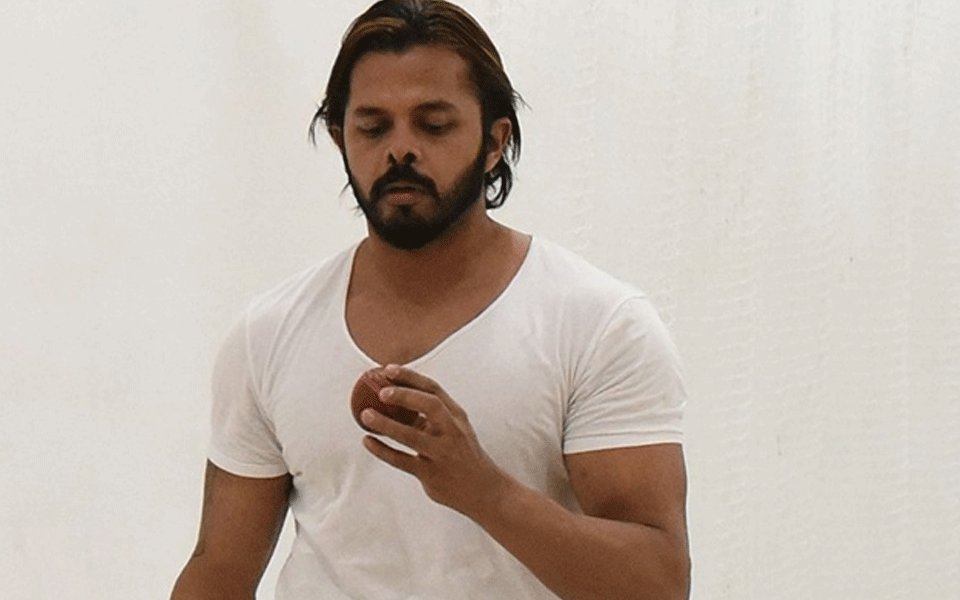
New Delhi, Jan 30: The Supreme Court Wednesday questioned banned cricketer S Sreesanth for not immediately bringing it to the notice of BCCI that he was being approached for alleged spot-fixing during the Indian Premier League (IPL) match in 2013.
The apex court observed that conduct of Sreesanth, who is facing life ban for his alleged involvement in the sensational spot-fixing scandal, in the entire episode was "not good".
Sreesanth, who was discharged by a trial court in 2015 in a criminal case related to alleged spot-fixing, told a bench of Justices Ashok Bhushan and K M Joseph that life ban imposed on him by the Board of Control for Cricket in India (BCCI) was harsh and there was no evidence to substantiate the claim that he was indulged in any illegality.
The 35-year-old cricketer has challenged in the apex court the decision of a division bench of the Kerala High Court which restored the ban imposed on him.
Senior advocate Salman Khurshid, appearing for Sreesanth, said it was not established that any spot-fixing was done in the match played between IPL teams Rajasthan Royals and Kings XI Punjab at Mohali in May 2013 and there was no evidence that the cricketer had received any payment for doing this.
"Why didn't you (Sreesanth) bring it immediately to the notice of the board (BCCI)?," the bench asked Khurshid after he referred to recorded telephonic conversations between alleged bookies.
The senior counsel said Sreesanth had failed to inform the board about him being approached for spot-fixing but even if he did not do this, the maximum ban that could be imposed upon him was five years.
"All this indicates that conduct of S Sreesanth was not good. There is no doubt about this," the bench said.
Khurshid argued that as per allegations, Sreesanth was supposed to concede 14 runs in an over but he gave away 13 runs in that over which he bowled to "two of the best batsmen" Adam Gilchrist and Shaun Marsh.
"At the worst, it could be said that I (Sreesanth) had the knowledge that somebody was trying to do fixing and I should have brought it to the notice of the authorities. If that is the case, the total ban could be up to five years," he said.
He said world over ban has been imposed on cricketers for indulging in such activities and except former South African captain Hansie Cronje, who later died in 2002 in a plane crash, life ban was not imposed on anyone.
Khurshid referred to the case of former Indian captain Mohammad Azharuddin, who was accused for his alleged involvement in a match fixing scandal of 2000, and said that life ban was imposed on him but later it was reversed.
On November 8, 2012, the Andhra Pradesh High Court had termed the life ban imposed by the BCCI on Azharuddin in match fixing scandal as illegal and said it is unsustainable in law.
"My (Sreesanth) desire is to get back my honour," Khurshid told the bench, adding, "Ultimately, I am wasting my professional career. At least, let me play outside India. Every year, I am getting offers to play.
"I have been given life ban for an offence which is not at all established," he said, adding that there was no evidence of payment of Rs 10 lakh to Sreesanth for the alleged fixing.
Khurshid said recorded telephonic conversations did not show that the match was fixed and evidence produced by Delhi Police was not accepted by the trial court.
Senior advocate Parag Tripathi, appearing for Committee of Administrators (CoA) of BCCI, raised the issue of veracity of translation of the telephonic conversations referred to by Sreesanth's counsel and said he needs to file a reply on this.
Tripathi said he would also respond to the additional documents filed by the petitioner.
The bench asked Tripathi to file his response and posted the matter for further hearing on February 20.
The apex court said that Sreesanth's counsel may also file the certified copy of complete transcripts of telephonic conversations that have been brough on record.
Sreesanth had earlier told the top court that he has offers to play English County matches and life ban imposed on him by the BCCI is "too harsh".
The apex court had last year asked the Delhi High Court to decide expeditiously the appeal filed by the Delhi Police challenging a trial court order discharging several accused, including Sreesanth, in the alleged spot-fixing case.
The Delhi Police had arrested Sreesanth, along with cricketers Ajit Chandila and Ankeet Chavan, and others on alleged charges of spot fixing during the IPL in 2013.
As many as 36 accused in the spot-fixing case, including Sreesanth, Chavan and Chandila, were discharged by a trial court here in July 2015.
The BCCI had, however, refused to alter its disciplinary decision of life ban on Sreesanth even after the trial court's verdict.
A single-judge bench of the Kerala High Court had lifted the life ban imposed on Sreesanth by the BCCI and had set aside all proceedings against him initiated by the board.
Later, a division bench of the high court had restored the ban on a petition filed by the BCCI against the single-judge bench's order.
Let the Truth be known. If you read VB and like VB, please be a VB Supporter and Help us deliver the Truth to one and all.
Death toll climbs to 16 in van-SUV collision in MP's Dhar
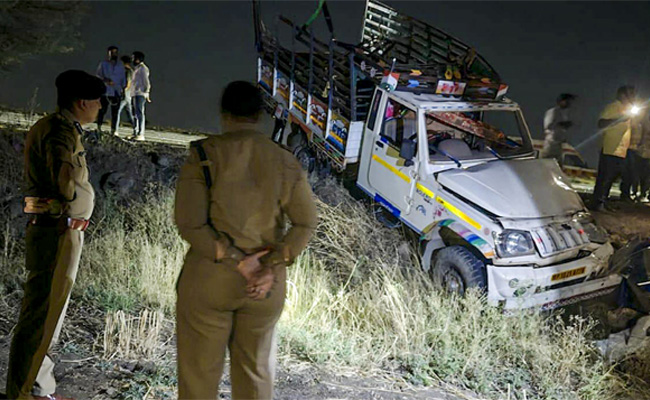
Dhar (MP) (PTI): The death toll in the collision between a pick-up van and an SUV in Madhya Pradesh's Dhar district has risen to 16, officials said on Thursday.
The van carrying labourers overturned and collided with a Sports Utility Vehicle (SUV) coming from the opposite direction near Chikliya crossing on the Indore-Ahmedabad National Highway on Wednesday night, they said.
Twelve fatalities were initially reported after the incident. Four more persons later succumbed to their injuries, taking the toll to 16, officials said.
"A very tragic incident occurred in Dhar. I was informed that 46 persons (mostly labourers) were travelling in a pickup vehicle. It overturned and caused an accident. We have received information about the deaths of 15 people. This is very unfortunate," Indore Divisional Commissioner Dr Sudam P Khade told reporters.
Later, one more person succumbed to his injuries, Dhar district hospital's civil surgeon Dr Mukund Burman said.
ALSO READ: ICSE, ISC results: Girls outperform boys, pass rate over 99%
Prime Minister Narendra Modi and MP Chief Minister Mohan Yadav have issued instructions to ensure all arrangements are made, and treatment is provided to the injured persons, and that no one is left without care, Khade said.
The divisional commissioner and Inspector General Anurag were monitoring relief operations at the incident spot.
"Seven injured persons have been referred for treatment to Indore. Fifteen people are undergoing treatment here. The patients here are currently stable, but if they need to be referred (elsewhere), everything will be done," Khade said.
"In Indore also, we have deployed a team of doctors and are making all arrangements so that there is no delay or problem in treatment," he added.
The incident occurred between 8.30 and 9 pm on Wednesday. The labourers were returning home in the van from Baggad in Dhar district when the driver lost control of the vehicle near Chikliya crossing.
The Tirla police have registered a case and are investigating the accident.
PM Modi on Wednesday expressed grief over the incident. An ex gratia of Rs 2 lakh each from PMNRF would be given to the next of kin of the deceased, and the injured would receive Rs 50,000.
CM Yadav said instructions have been given to provide Rs 4 lakh each to the families of the deceased, Rs 1 lakh each to the seriously injured, and Rs 50,000 each to the injured.
Dhar district in-charge minister Kailash Vijaywargiya said instructions have been given to the local administration to ensure that the injured receive proper treatment.
Leader of Opposition, Umang Singhar, a native of Dhar district, also expressed grief over the accident.