Sifan Hassan wears hijab on Olympic podium after record-breaking marathon win

Paris: Sifan Hassan of the Netherlands set an Olympic record in the women’s marathon, the final track and field event of the Paris Games, with a time of 2 hours, 22 minutes, and 55 seconds. Her performance, especially in the last 250 meters, secured her the gold medal.
However, her victory was marked by more than just her athletic prowess. Hassan accepted her gold medal during the final podium ceremony at the Olympics 2024 wearing a hijab. This act held particular significance as it occurred against the backdrop of France’s controversial decision to ban France's female athletes from wearing hijabs during the competition.
The sight of Hassan receiving her medal while wearing her hijab resonated globally, drawing widespread applause from fans.
Social media erupted with support, praising her courage in standing against the ban.
ALSO READ: Extraordinary Paris Olympics draws to a close with spectacular show
Many users highlighted the contrast between her victory and France’s policy, calling it a powerful statement against the country’s stance on religious attire.
Criticism of France’s decision has been extensive, with the Islamic Solidarity Sports Federation and Amnesty International both arguing that the ban contradicts the Olympics' values of equality, inclusion, and respect for cultural diversity. Amnesty International had expressed these concerns just a week before the Games began.
Hassan’s triumph in the marathon caps a remarkable journey. A former Ethiopian asylum-seeker, she won three long-distance running medals in just six days, including a bronze in both the 10,000m and 5,000m events. Her achievement makes her the first athlete since Emil Zatopek in 1952 to medal in all three distance events at a single Games.
Hassan's legacy was already significant before these Games. At the Tokyo 2020 Olympics, she won gold in both the 5,000m and 10,000m, as well as a bronze in the 1,500m, making her the first athlete to medal in both middle and long-distance events at the same Olympics. With her latest victory, she also became the only woman to win gold medals in all three long distance running events: 5,000m, 10,000m, and the marathon.
Let the Truth be known. If you read VB and like VB, please be a VB Supporter and Help us deliver the Truth to one and all.
JD(S) attacks K’taka govt over fuel prices, accuses it of mobilising funds for guarantee schemes
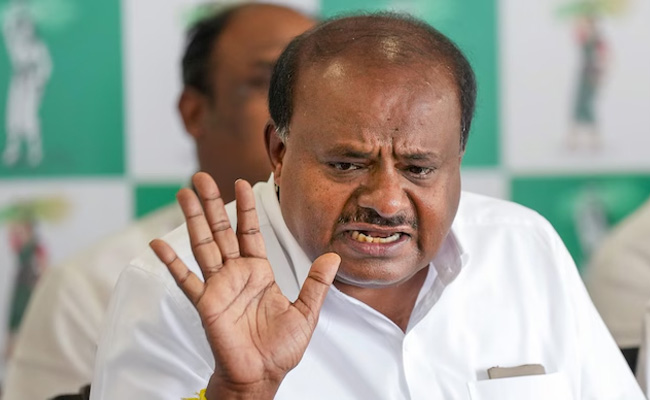
Mysuru (PTI): Union Minister H D Kumaraswamy on Sunday launched a sharp attack on the Congress government in Karnataka over petrol and diesel prices, accusing it of "misleading the public" while repeatedly raising taxes and fuel prices to finance its guarantee schemes.
Addressing a public outreach programme titled 'Janarondige Janata Dal' (Janata Dal with the people) and a membership campaign in the Chamundeshwari Assembly constituency in Mysuru, the JD(S) state president challenged Congress leaders to make public the number of tax hikes and price increases imposed by the state government over the last three years.
"On one hand, the government is deceiving people by claiming to provide guarantees, while on the other, it is repeatedly increasing prices. Let the Congress government release a list of how many times it has imposed taxes and raised prices," Kumaraswamy said.
He alleged that the Congress government had continuously increased taxes and prices on liquor, bus fares, electricity, and several other sectors to mobilise funds for its five guarantee schemes—Gruha Lakshmi, Gruha Jyothi, Anna Bhagya, Shakti, and Yuva Nidhi.
Kumaraswamy also criticised Congress leaders for attacking the Centre over fuel price hikes and asked them to introspect on their own contribution to the state’s development before holding the proposed 'Sadhana Samavesha' (achievement convention) on May 19.
Referring to the global oil situation, he said the ongoing conflict involving the United States, Israel, and Iran had triggered an international oil supply crisis and argued that fuel prices in India remained lower than in many developed countries.
"In Singapore, which is a developed country, petrol costs Rs 245. Congress leaders should open their eyes and see this," he claimed.
He further questioned what the Congress party would have done had it been in power during the present international crisis.
"Did anyone foresee that such a war would take place? If Congress leaders had such foresight, let them say so. If the Congress party itself had been in power during such a difficult situation, what would it have done?" Kumaraswamy asked.
Throughout his address, the former CM mounted a sustained attack on Congress leaders and dismissed claims that guarantee schemes had improved people’s lives.
"Congress leaders think people are living peacefully because of the guarantee schemes. That is wrong," he said.
Recalling the by-election scenario in the Chamundeshwari constituency in 2006, Kumaraswamy said JD(S) had suffered defeat due to internal mistakes within the party.
"If our leaders had been cautious then, the situation would not have reached this stage. JD(S) suffered defeat because of some mistakes on our part," he said.
He added that he shared a deep bond with the constituency.
Calling upon party workers to prepare for the next Assembly elections, Kumaraswamy expressed confidence that JD(S) would win 75 seats in the next polls and asserted that Chamundeshwari constituency would return to the party in 2028.
"There is no confusion in our party," he said, adding that JD(S) would not bow to any pressure and that the convention had been organised to strengthen its presence in Chamundeshwari.
"Our party has lakhs of loyal workers as its backbone. JD(S) remains strong even today because of the hard work of our cadre," he said.
Kumaraswamy also claimed that during his tenure as CM, he had sanctioned more funds for the Chamundeshwari constituency than the present CM (Siddaramaiah).
"We are not holding this convention to oppose anyone. We are organising it to inform the people about the failures of the state government," he said.
Addressing the gathering in a traditional turban, Kumaraswamy said the gesture was intended to send a message to the Hallumatha and Kuruba communities and reassure them of JD(S) support.
"JD(S) is working for Kurubas, Dalits, and minorities. I am not helping distressed people for publicity. I do it out of self-satisfaction and duty," he said.