Schools to reopen in England from September

London: The UK government on Thursday unveiled plans for the compulsory reopening of all schools in England from September after months of closure due to the coronavirus lockdown, on the broad principle of keeping classes apart in separate "bubbles".
Besides a host of safety measures to be put in place by individual schools, if there are two confirmed coronavirus cases in a 14-day period, all the pupils in that class bubble, or in some cases even the whole school, may have to be sent home.
I know these past three months have been some of the most challenging that schools have faced, said UK Education Secretary Gavin Williamson, who made the announcement in a House of Commons statement.
Nothing can replace being in the classroom, so ever since schools, colleges and nurseries closed to most children, we have been working hard to ensure they can reopen as soon as possible. We have already seen more than 1.5 million children and young people return, but we must make sure all pupils can go back to school in September, giving them the opportunity to thrive and fulfill their potential, he said.
The Department for Education said that its guidance, developed in close consultation with the sector and medical experts, provides schools, colleges and nurseries with the details needed to plan for a full return, as well as reassuring parents about what to expect for their children.
I want to reassure parents and families that we are doing everything we can to make sure schools, nurseries, colleges and other providers are as safe as possible for children and staff, and will continue to work closely with the country's best scientific and medical experts to ensure that is the case, added Williamson.
The government said that COVID-19 secure measures will remain in place to reduce the risk of transmission, with schools being asked to keep children in class or year group sized bubbles and encourage older children to keep their distance from each other and staff where possible. This is alongside protective measures such as regular cleaning and handwashing.
Where an outbreak in a school is confirmed, for specific detailed investigations a mobile testing unit may be dispatched to test others who may have been in contact with the person who has tested positive.
Testing will first focus on the person's class, followed by their year group, then the whole school if necessary. Schools will be expected to have plans in place to offer remote education to pupils who are self-isolating.
A child's education is essential to their healthy development - we know that missing too much school can have a negative impact on children's mental and physical wellbeing, said Dr Jenny Harries, England's Deputy Chief Medical Officer.
Everybody wants children to be safe and thankfully as we have learned more about COVID-19, the evidence has shown that the risk of severe disease in children is low. However, although the number of COVID-19 cases has declined, it is still in general circulation - so it is important we ensure schools implement sensible precaution to reduce potential transmission of COVID-19 and minimise any risk to teachers and their pupils, she said.
The government said that to ensure pupils can catch up on lost learning, schools will be required to resume teaching a broad and balanced curriculum in all subjects, making use of existing flexibilities to create time to address gaps in knowledge, with a view to conducting exams in 2021.
Nurseries and other early years providers, including childminders, have already been operational in England with a range of protective measures in place. The devolved administrations of Scotland, Wales and Northern Ireland will set out their specific strategies based on the UK government guidance.
Let the Truth be known. If you read VB and like VB, please be a VB Supporter and Help us deliver the Truth to one and all.
MP cruise boat tragedy: Search ops expanded to trace four missing passengers
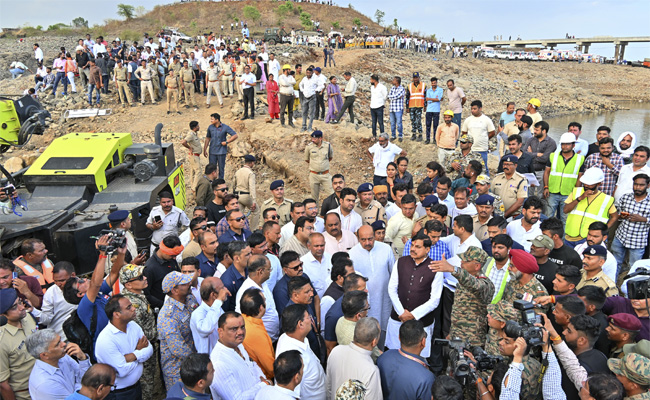
Jabalpur (PTI): Army divers and disaster response teams on Saturday expanded their search at Bargi Dam in Madhya Pradesh to locate a man and three children still missing after the cruise boat tragedy that claimed nine lives two days ago, officials said.
With 28 of the 41 identified passengers onboard the ill-fated cruise boat rescued safely, police are preparing to register an FIR in connection with the accident that occurred at the reservoir in Jabalpur district on Thursday evening, they said.
The search radius has been expanded to 5 km in the backwaters of the Bargi Dam, located downstream of the Narmada River, area sub-divisional officer of police (SDOP) Anjul Ayank Mishra told PTI.
Nine people drowned in the incident, while 28 were rescued, and efforts are ongoing to trace the missing persons, he said.
ALSO READ: Alleging unauthorised sorting of postal ballot covers, TMC files complaint with EC
According to the police, more than 200 rescuers, including around 20 Army divers airlifted from Agra, began the search operation at 5 am on Saturday to trace Kamraj, an employee of the Ordnance Factory in Khamaria, his son Tamil (5), Vijay Soni (6) and Mayuram (5).
Mishra said that an inquest case has been registered and the post-mortem of nine deceased persons has been completed.
"Our priority is to search for the missing persons. We will soon register an FIR," he said.
Investigators have said that CCTV footage near the boarding point showed 43 people heading towards the ill-fated boat, and the names of 41 persons, who boarded the vessel, have been ascertained so far.
Collector Raghvendra Singh confirmed that a search is underway for four missing persons.
The rescue operation, being carried out by the National Disaster Response Force (NDRF), State Disaster Response Force (SDRF) and local divers, was briefly affected around 9 am due to strong winds.
The state government on Friday ordered a probe into the incident and dismissed three crew members after survivors alleged negligence and safety lapses, including failure to provide life jackets.
The government also banned the operation of similar vessels in the state.
The boat, operated by the state tourism department, sank during a sudden storm around 6 pm on Thursday, and the wreckage was retrieved from the dam water on Friday, after the rescuers confirmed that there were no more bodies inside.
Eyewitnesses have said that strong winds made the water choppy, prompting passengers to raise an alarm and ask the crew to steer the vessel towards the riverbank.
A survivor alleged negligence by the crew and described a last-minute scramble for life jackets.