Thailand releases 18 Cambodian prisoners of war as part of ceasefire agreement

Bangkok (AP): Thailand on Wednesday released 18 Cambodian prisoners of war held for five months, fulfilling the terms of a ceasefire agreement the two countries signed to end bitter fighting along their border.
The release was stipulated in the ceasefire agreement signed Saturday by the defence ministers of the two countries at the same border checkpoint between Thailand's Chanthaburi province and Cambodia's Pailin province where the soldiers were released.
“The repatriation of the 18 Cambodian soldiers was undertaken as a demonstration of goodwill and confidence-building, as well as in adherence to international humanitarian principles,” Thailand's Foreign Ministry said in a statement.
Cambodia's Defence Ministry said the release “creates an environment conducive to peace, stability, and the full normalisation of relations for the benefit of both nations and their people in the near future.”
The soldiers' release removes a major impediment toward that goal after two rounds of destructive combat over competing territorial claims.
Thailand had insisted it was allowed to hold the men under provisions of the Geneva Conventions governing the rules of war, which says they could be detained until the end of hostilities. The prisoners were allowed visits by the International Committee of the Red Cross and other rights covered under international humanitarian law, Thai authorities said.
Their continued detention was used effectively by Cambodia's government to rally nationalist sentiment in the conflict against Thailand.
Wednesday's statement from Cambodia's defence ministry said the government “has remained steadfast in the promise made to the families of the 18 soldiers and the Cambodian people: that no soldier would be left behind.”
The ceasefire agreement said the soldiers would be freed if the end of combat was sustained for 72 hours after it came into effect at noon on Saturday. The 72 hours passed on Tuesday, but Thai authorities said they needed to evaluate the situation, claiming that 250 Cambodian drones had been active along the border.
The two countries had given differing accounts of the circumstances of the men's capture, which took place on the same day the initial ceasefire came into effect at the end of July.
Cambodian officials say their soldiers approached the Thai position with friendly intentions to offer post-fighting greetings, while Thai officials said the Cambodians appeared to have hostile intent and entered what Thailand considers its territory and subsequently were taken prisoner.
There were originally 20 Cambodia soldiers taken captive, but two were repatriated within days for what were said to be medical reasons.
The original July ceasefire was brokered by Malaysia and pushed through by pressure from US President Donald Trump, who threatened to withhold trade privileges unless Thailand and Cambodia agreed. It was formalised in more detail in October at a regional meeting in Malaysia that Trump attended.
Despite those deals, the countries carried on a bitter propaganda war and minor cross-border violence continued, escalating in early December to widespread heavy fighting.
Thailand lost 26 soldiers and one civilian as a direct result of the combat since December 7, according to officials. Thailand also reported 44 civilian deaths.
Let the Truth be known. If you read VB and like VB, please be a VB Supporter and Help us deliver the Truth to one and all.
MP boat tragedy: Death toll rises to 10 with recovery of one more body; 3 tourists still missing
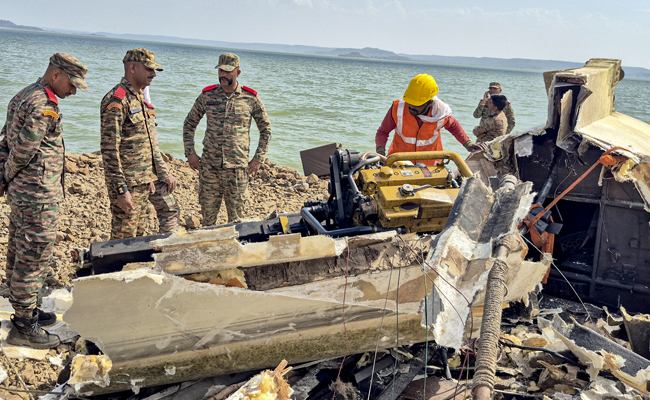
Jabalpur (PTI): The body of a child was retrieved on Saturday evening from Bargi Dam in Jabalpur district of Madhya Pradesh, raising the death toll in the cruise boat tragedy that took place two days ago to ten, while search continued for three missing tourists.
The boat, operated by the state tourism department, capsized during a storm on Thursday evening with some of the survivors alleging negligence and safety lapses such as life jackets not being distributed in time.
The body recovered on Saturday evening was possibly that of six-year-old Viraj Soni, said Sub-Divisional Officer of Police (SDOP) Anjul Ayank Mishra.
"The identity will be confirmed after family members identify the body," he told PTI.
Kamraj, an employee of the Ordnance Factory at Khamaria, his five-year-old son Tamil, and another child Mayuram (5) who had come from southern India were still missing.
Authorities have arranged equipment to search deep waters of the dam and are getting a generator to facilitate diving operations, Mishra added.
Divers and disaster response teams have expanded the search radius to five km, he said.
Of the 41 identified passengers on board the ill-fated vessel, 28 were rescued, police said.
More than 200 rescuers, including around 20 Army divers airlifted from Agra, joined the search operation that resumed at 5 on Saturday morning. The operation, involving the National Disaster Response Force, State Disaster Response Force and local divers, was briefly affected at around 9 am due to strong winds, officials said.
Post-mortem examinations of nine deceased persons have been completed, Mishra said.
"Our priority is to search for the missing persons. We will also register a First Information Report in the case soon," he said.
Police said CCTV footage near the boarding point showed 43 people heading towards the boat while the identities of 41 passengers have been confirmed so far.
The state government on Friday ordered a probe into the tragedy and dismissed three crew members. It also banned operation of similar vessels in the state.