US vetoes UNSC resolution calling for immediate humanitarian ceasefire in Gaza
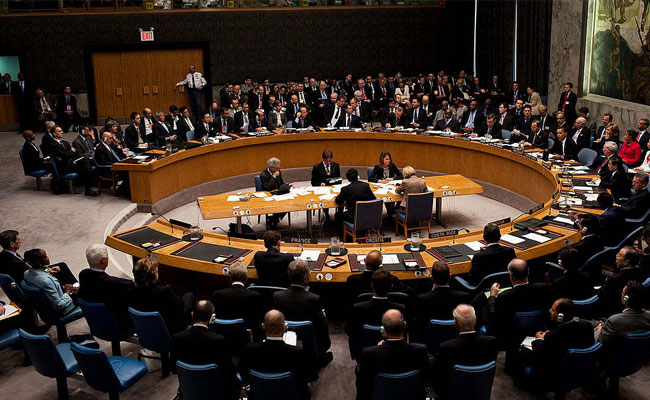
United Nations (PTI): The US has vetoed a draft resolution on the Israel-Hamas war in the UN Security Council that would have demanded an immediate humanitarian ceasefire in Gaza and the immediate and unconditional release of all hostages taken by the Hamas.
The 15-nation Council met on Friday to vote on the resolution tabled by the United Arab Emirates and backed by over 90 member states. The resolution got the backing of 13 Council members who voted in its favour while the United Kingdom abstained.
The voting on the resolution came after UN Secretary-General Antonio Guterres, in a rare move, had invoked Article 99 of the UN Charter to appeal to the Security Council for a humanitarian ceasefire in the Israel-Hamas war and to avert a "humanitarian catastrophe," which he said has potentially irreversible implications for Palestinians and peace and security in the region.
Ahead of the vote, Guterres urged the Council to "spare no effort" to push for an immediate humanitarian ceasefire, for the protection of civilians, and for the urgent delivery of lifesaving aid.
In the Explanation of Vote, US Ambassador Robert Wood, Alternative Representative for Special Political Affairs, said it is incomprehensible why the resolution's authors have "declined to include language condemning Hamas' horrific attack" on Israel on October 7.
He said that despite a "rushed process" and "lack of appropriate consultation" by the resolution's authors, the United States engaged in "good faith" on the draft resolution.
"We proposed language with an eye toward a constructive resolution that would have reinforced the life-saving diplomacy we have undertaken since October 7; increased opportunities for humanitarian aid to enter Gaza; encouraged the release of hostages and the resumption of humanitarian pauses; and laid a foundation for a durable peace," he said.
Wood said "unfortunately, nearly all of our recommendations were ignored. And the result of this rushed process was an imbalanced resolution that was divorced from reality, that would not move the needle forward, on the ground, in any concrete way. And so, we regretfully could not support it."
UAE's Ambassador and Deputy Permanent Representative Mohamed Abushahab expressed deep disappointment with the outcome of the vote.
"Regrettably, and in the face of untold misery, this Council is unable to demand a humanitarian ceasefire," Abushahab said.
"Let me be clear. Against the backdrop of the Secretary-General's grave warnings, the appeals by humanitarian actors, and the world's public opinion this Council grows isolated. It appears untethered from its own founding document," the UAE envoy said.
He questioned what message the Council is sending "Palestinians if we cannot unite behind a call to halt the relentless bombardment of Gaza? Indeed, what is the message we are sending civilians across the world who may find themselves in similar situations?"
UK's Permanent Representative to the UN Ambassador Barbara Woodward said her country cannot vote in favour of a resolution which does not condemn the "atrocities" Hamas committed against innocent Israeli civilians on October 7.
Calling for a ceasefire ignores the fact that Hamas has committed acts of terror and is still holding civilians hostage, she said.
"Israel needs to be able to address the threat posed by Hamas and it needs to do so in a manner that abides by international humanitarian law so that such an attack can never be carried out again," she said.
And so that we can work meaningfully towards a two-state solution, which delivers statehood for the Palestinians, security for Israel, and peace for people on both sides," she said
"That's why we abstained on this resolution," she added.
Guterres said that he had written to the Council invoking Article 99 "because we are at a breaking point. There is a high risk of the total collapse of the humanitarian support system in Gaza, which would have devastating consequences."
"We anticipate that it would result in a complete breakdown of public order and increased pressure for mass displacement into Egypt," he said.
The UN chief voiced concern that the consequences could be devastating for the security of the entire region.
"We have already seen the spillover in the Occupied West Bank, Lebanon, Syria, Iraq and Yemen. There is clearly, in my view, a serious risk of aggravating existing threats to the maintenance of international peace and security," Guterres said.
In his letter invoking Article 99, Guterres noted that more than 1,200 people were brutally killed, including 33 children, and thousands were injured in the attack by Hamas and other Palestinian armed groups on October 7, which he has "repeatedly condemned".
Guterres voiced concern that civilians throughout Gaza face grave danger. Since the start of Israel's military operation, more than 15,000 people have reportedly been killed, over 40 per cent of whom were children, he said.
UN director at Human Rights Watch Louis Charbonneau said that once again the US used its veto to prevent the Security Council from making some of the calls the US itself has been demanding of Israel and Palestinian armed groups, including compliance with international humanitarian law, protection of civilians, and releasing all civilians held hostage.
"By continuing to provide Israel with weapons and diplomatic cover as it commits atrocities, including collectively punishing the Palestinian civilian population in Gaza, the US risks complicity in war crimes," Charbonneau said.
Let the Truth be known. If you read VB and like VB, please be a VB Supporter and Help us deliver the Truth to one and all.
Man arrested in Hyderabad for impersonating police officer using AI videos

Hyderabad (PTI): A 27-year-old man was arrested in Hyderabad for allegedly impersonating a police official and uploading fabricated videos on social media platforms to gain followers, police said on Wednesday.
The accused, who worked as a delivery executive with a food delivery aggregator, created and circulated misleading videos using AI-based software.
He falsely depicted himself as a police official and showcased weapons, potentially causing panic and misleading the public, a release from Hyderabad Police said.
Police said it came to their notice that fake videos were being circulated on social media, showing individuals posing as police personnel and displaying weapons.
Upon preliminary inquiry, it was found that the videos were fabricated using AI software and did not represent any real police activity.
The accused unlawfully impersonated a police official and created deceptive digital content, which is a punishable offence under relevant provisions of law.
Such acts can erode public trust and create unnecessary alarm, the release said.
Acting on credible information, police teams apprehended the accused and seized a mobile phone used in the offence.
A case under relevant sections of the BNS and the IT Act, 2000, was registered at Kalapathar Police Station.
Further investigation is underway to determine whether any other persons were involved in the creation and dissemination of such content, police added.