Rohit Sharma overtakes Sachin Tendulkar to record most centuries in World Cup history

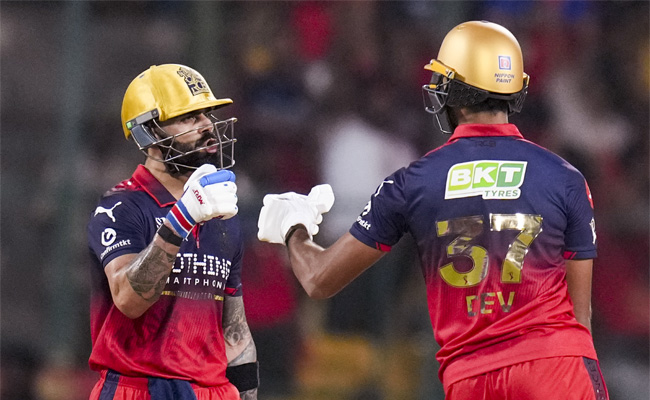
New Delhi(PTI): Captain Rohit Sharma on Wednesday became the first Indian to score seven world cup hundreds, surpassing the legendary Sachin Tendulkar during their clash against Afghanistan here.
While Tendulkar recorded six centuries in as many editions of World Cups that he played -- 1992, 1996, 1999, 2003, 2007 and 2011, Rohit achieved the feat in only three: 2015, 2019 and 2023.
Rohit also holds the record of scoring most centuries (five) by any batter in a World Cup edition -- a feat that he achieved in 2019 in England.
Rohit's ton against Afghanistan was his 31st overall, taking him past Australian legend Ricky Ponting. He is now behind India's Virat Kohli (47) and Tendulkar (49) in the history of ODI cricket.
Rohit also broke Kapil Dev's (72) record of fastest ODI century for India in World Cup history, moving into triple figures off just 63 balls (12x4s, 4x6s).
In imperious form during India's chase of 273 against Afghanistan, Rohit also went past West Indies' Chris Gayle (553 sixes across formats) to record most sixes hit in international cricket across formats.
Rohit completed his half-century off just 30 balls second fastest in the edition so far while hitting three sixes and seven fours to make 60 unbeaten off 32 balls at the end of the eighth over.
Rohit unleashed his signature pull shot to hit Afghanistan bowler Naveen-Ul-Haq on the penultimate ball of the eighth over to overtake Gayle. Pakistan's Shahid Afridi is third in the list with overall 476 sixes.
In the process, the Indian skipper also joined Australia's David Warner in taking least number of innings (19) to complete 1,000 runs in World Cup history.
Among other Indians, Tendulkar (20) and Sourav Ganguly (21) feature among those with quickest to 1,000 runs in World Cups.
Let the Truth be known. If you read VB and like VB, please be a VB Supporter and Help us deliver the Truth to one and all.
T'gana RTC strike: Talks between govt, employees successful

Hyderabad (PTI): Talks between employees of Telangana State Road Transport Corporation (RTC) who were on strike and the state government concluded successfully on Friday as the government agreed to the key demands of the workmen.
Following a day-long marathon of talks between the leaders of the employees' Joint Action Committee (JAC) and the cabinet sub-committee, the government announced after midnight that it acceded to the demands, including a merger of RTC with the government, 11 per cent pay revision and elections to the employees' unions.
A committee comprising officials and employee leaders would be appointed over the merger of RTC with the government, it said.
The RTC management has also agreed to address the remaining issues as well, an official release said.
The employees would call off their strike and the RTC buses would hit the roads shortly, it said.
The employees had been on an indefinite strike since April 22 over a series of demands, including the merger of RTC with the government.
Earlier in the day, a driver of the RTC, who attempted suicide on April 23 during the strike, died at a hospital here in the early hours of Friday.
Shankar Goud, a 55-year-old driver, set himself ablaze by pouring petrol at Narsampet in Warangal district when the employees were staging a protest on Thursday in support of their demands.
Goud suffered serious burns, was initially admitted to a state-run hospital in Warangal, and later shifted to a super-speciality hospital in Hyderabad for advanced treatment.
"He succumbed (to injuries) at about 1.30 am on Friday," a senior official said.
The driver’s body was taken to his relative’s village, Muttojipet in Warangal district, for funeral rites.
Tension prevailed in Muttojipet as his family members and RTC employees attempted to take the body to the Narsampet bus station, where he worked, to enable his colleagues to pay their last respects. However, police did not permit this, citing law-and-order concerns.
This led to a deadlock before the funeral could proceed.
Union Minister Bandi Sanjay Kumar criticised the Telangana government for not allowing the body to be taken to the Narsampet bus station.
Kumar, Minister of State (Home), visited Muttojipet village in Warangal district, where the funeral was held, and paid homage to Goud.
“They (family members) want to take the body to the bus depot for five minutes. Is the RTC bus depot in Pakistan or Bangladesh? They are emotionally attached to taking the body there. The government is hurting sentiments and creating fear among RTC employees,” Kumar told reporters.
He also expressed anger at the police for not allowing the body to be taken to the bus station and staged a protest, according to a release from his office.
RTC employees and BJP workers attempted to take the mortal remains in an ambulance to Narsampet, but were stopped by the police.
Later, after discussions with the police, the family members and RTC employees agreed to conduct the funeral in the village.
Sanjay Kumar, stating he would abide by the family’s decision, left the village after the funeral was conducted there.
Transport Minister Ponnam Prabhakar said an ex gratia of Rs 10 lakh, a house, and a government job would be provided to the kin of Goud.
Chief Minister A Revanth Reddy expressed shock over the employee’s death and conveyed deep condolences to the grieving family, according to the release.
The RTC employees’ JAC had earlier announced an agitation programme from April 24 to 29, including silent marches and submission of memorandums to MLAs and other leaders.